
Start with the money coming in, not the thing that annoys you. Almost every business we meet wants a specific irritation fixed first, and almost every one of them is losing more money somewhere else. Fix the enquiries that are never answered, and the abandoned orders that are never chased, before you touch anything else.
Workflow automation means letting software carry a process from one step to the next without a person pushing it along. In a small business, the workflows worth automating are the ones that happen every day, follow a pattern you could write down, and end in a result you can check.
The mistake we are asked to fix second
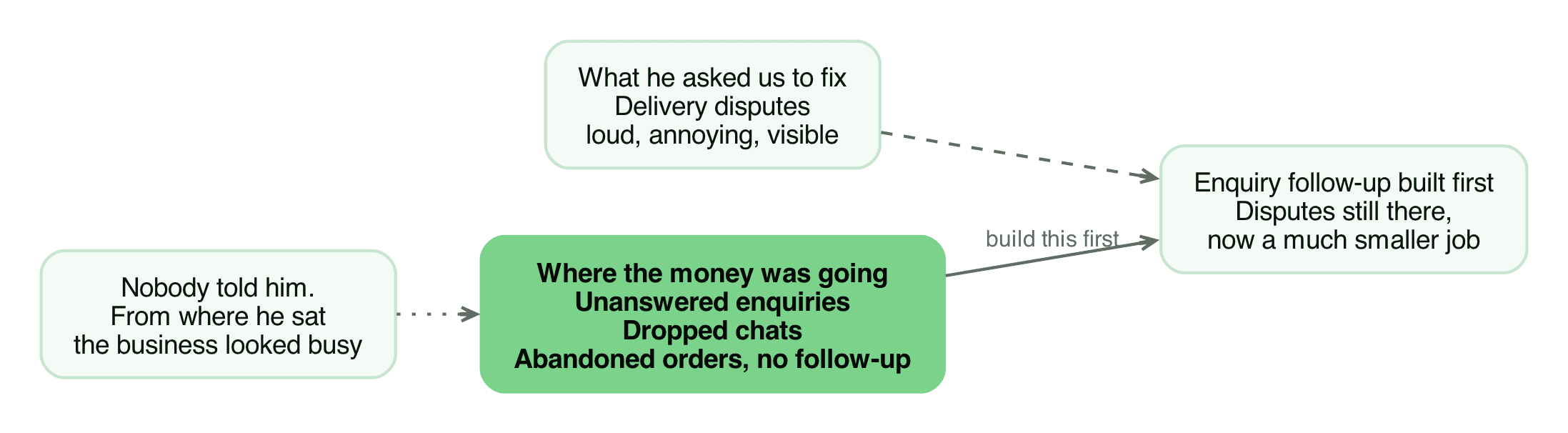
A founder came to us wanting help with delivery disputes. Customers and the logistics company were arguing, he was stuck in the middle, and it was eating his week. He wanted that fixed, and he was right that it was a problem.
He was losing more money somewhere he was not looking. His virtual assistants were buried in unanswered questions from buyers. Chats were falling through and nobody was going back to them. Orders were being abandoned and never followed up. Nobody had told him, because from where he sat the business looked busy.
He had the annoying problem in his mouth and the expensive one in his inbox. We built the enquiry follow-up first. The delivery disputes are still there, and they are a much smaller job now that the money is not leaking out of the front door.
If you are choosing between two things to automate, work out which one is quietly costing you money before you pick the one you can describe in a meeting.
How to choose, with numbers instead of feelings
Write down every process that repeats at least weekly, then score each one on four things.
- How often. Twenty times a week is a candidate. Twice a week is a hobby.
- How long each run takes, including the switching. A five minute job done forty times a week is three and a half hours.
- What a mistake costs. A mistyped delivery address means a resend. A wrong quote means margin or a lost customer.
- Whether software can tell it worked. This is the one everyone skips, and it decides whether you can trust the automation.
Rank by how often multiplied by how long, then drop anything where mistakes are expensive and nothing can check the result. What is left is your shortlist.
What we have actually built
These are the four that come up most, and what happened on each.
Taking food orders inside WhatsApp, for a vendor. Customers message, choose from the menu and pay without leaving the app. This is nearly always the first thing worth building, because the volume is high, the answers are checkable, and the cost of a wrong answer is small as long as payments and complaints go to a person.
Bill payments on a schedule, for CIP TopUp. CIP TopUp is a bill payment platform, so the automation lets a customer set a payment to run on an interval rather than buying each time, alongside their normal one-off purchases.
Receipts and bookkeeping, for a UK accounting agency. They had over 300 clients. Their team photographed receipts, read the details, typed them in, then classified each one before it reached Xero. Xero's own tools did not fit, because the agency files things in ways Xero was not designed to accept. We built the scanning and the custom classification to match how they actually work, rather than asking them to work the way the software wanted.
Inheriting a system that was already breaking. We took over a talent search tool built for a recruiting firm. Their data pipeline was fine at low volume and started failing as the volume grew, and the errors were quiet. The lesson worth taking from that one is simple. When you inherit an automation, the first job is not to add to it. Find out what it assumes about volume, then check whether that assumption still holds.
What to leave alone, for now
- Negotiation. Pricing an unusual order depends on context, history and how the customer is speaking to you that day.
- Complaints. An apology from software reads worse than a slow apology from a person.
- Anything with no clear finish. "Improve customer satisfaction" cannot be automated, because the system will never know whether it succeeded.
- Processes that change every month. Automation pays off when things stay stable. If the process is still being redesigned, wait.
- Work where the person is the product. A tailor's fitting, a consultant's first call, a chef's tasting. Automate around these, not through them.
What it costs to start, and what it costs to run
The starting cost is the part nobody publishes, so here is ours.
Getting a consultation is free. If you want the plan written down before you commit to anything, that is ₦30,000. A build starts at ₦564,000, and that is the smallest project we will take on.
What runs afterwards is what surprises people.
- Platform subscriptions. Most workflow tools bill in dollars, per task or per run. A cheap plan gets expensive when volume grows, so check what happens at ten times what you use now.
- The AI part. Text model calls are cheap and predictable. Voice minutes are not, and long conversations add up quickly.
- Messages. WhatsApp now charges businesses per message. We broke down the October 2026 change and what it costs. Work out your monthly volume before you commit to a channel.
- Hosting, if you run the tool yourself. That is a dollar server bill and the uptime is your problem.
- Fixing it later. Small changes, breakage when a platform updates, and someone keeping an eye on it. A system with nobody looking after it stops working within a quarter.
Agree the exchange rate you are planning at before you approve anything that bills in dollars. It is not a detail, it is a line in the budget.
The order that stops projects stalling
- Get your records into one place. One customer list, one product list, one price list. It is the least impressive step and everything else depends on it.
- Answer the enquiries, with a clear handover to a person.
- Follow up, with a clear stopping point on every sequence.
- Capture documents and reports, which are only useful once the records are clean.
- Connect the rest, one thing at a time, with alerts on failures and a person responsible for exceptions.
Skipping step one is the most common reason projects die. An automation reading three different price lists will confidently give you the wrong answer.

How to tell whether it worked
Pick three numbers before you start and keep them visible. How fast the first reply goes out. How many conversations finish without an employee touching them. What each resolved conversation costs once subscriptions, message fees and model usage are counted.
If response time improves but cost does not, you bought speed rather than savings. That can still be the right trade, since a faster reply often wins the sale. Just be honest about which one you paid for.
Where we come in
We look at the process first and build the smallest thing that removes the repetitive part. If you want to see how that works for a business like yours, start with our AI automation practice. If you already know which process is costing you money, tell us what it is and we will tell you whether automating it is worth automating.
Work with us
We design, build and automate the software Nigerian businesses grow on.
Stay in the loop
Get the latest updates and insights delivered to your inbox.
More like this
CRM for Small Businesses That Still Run on Memory
If customer records live in your head, a notebook and WhatsApp, here is the simplest CRM for small business in Nigeria, what it costs, and when software is worth it.
Read ArticleEcommerce Websites in Nigeria: Shopify vs WooCommerce vs Custom
What each ecommerce route costs in naira in 2026, what Paystack and Flutterwave take, what delivery really does to your margin, and which one fits your volume.
Read Article