
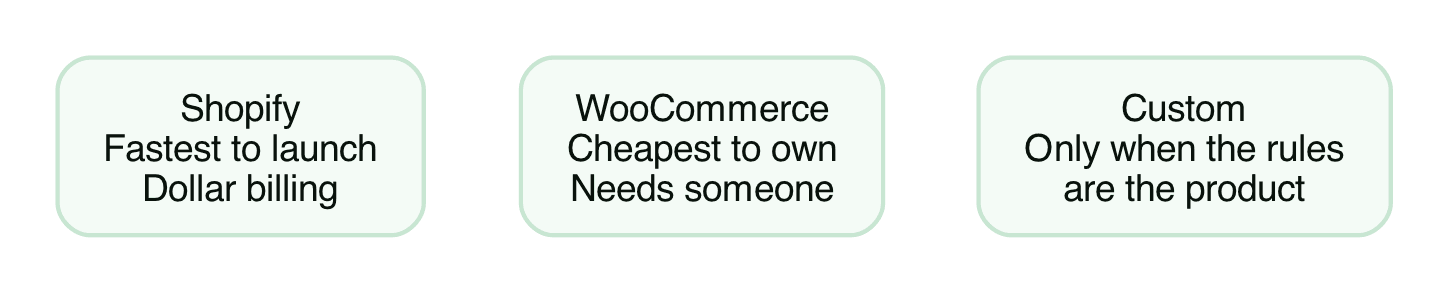
For most Nigerian businesses selling 50 to 500 products, WooCommerce on a Nigerian host is the cheapest route that you fully own, Shopify is the fastest to launch but charges you in dollars forever, and a custom build only makes sense when your checkout, delivery or pricing rules are the product. The platform matters far less than two other things: how you collect money and how you deliver.
That is the short answer. The long answer is that most "which platform" arguments are settled in the first week and then you spend three years living with delivery costs, failed payments and a stock list that never matches reality.
Start with the two questions that decide everything
Before platform, answer these.
- How do customers pay you? Card, transfer, or pay on delivery. Pay on delivery changes the whole economics, because a failed delivery is your loss and the rider still gets paid.
- Who moves the goods? Your own rider, a third-party logistics company, or pickup only. Each one dictates what your checkout must collect and what your order screen must show.
A store that answers both questions well on a ₦400,000 WooCommerce build will outsell a ₦2,000,000 custom build that ignores them.
Shopify: fastest to launch, priced in dollars
Shopify gets you selling in days. Hosting, security, the checkout and the payment integrations are handled, and the admin is the easiest of the three to learn.
- Strengths. Launch speed, a reliable checkout, a large app store, and no server to maintain.
- Weaknesses in Nigeria. Subscription and app charges are in dollars with a card, transaction fees apply on top of your gateway, and the cheap-but-essential apps each add a monthly line. Two or three apps and you have doubled the plan.
- Best for. A brand testing a new product line quickly, or a business without anyone technical who needs to be selling this month.
The dollar billing is the part people underestimate. At a volatile exchange rate, a plan that looked affordable in January can be a different number by June, and you cannot pay it from a naira account without converting first.
WooCommerce: cheapest to own, needs someone
WooCommerce is WordPress with a store plugin. You pay for hosting, a domain, a theme and a few extensions, and you own all of it.
- Strengths. No per-sale platform cut, naira hosting from Nigerian providers, and full control of the data. It handles 50 to 500 products comfortably on a decent host.
- Weaknesses. You or someone you pay owns updates, backups, security and plugin conflicts. WordPress sites get attacked constantly, and a store that sells without updates is a liability.
- Best for. A Nigerian business with a moderate catalogue, a small maintenance budget, and either an in-house person or a developer on retainer.
Do not run a live store on the cheapest shared hosting plan. A store that times out during a campaign is worse than no store.
Custom build: only when the rules are the product
Custom makes sense when your commercial model is unusual: wholesale pricing per customer tier, credit limits, a subscription box, a marketplace with multiple sellers, or a checkout that must work in a very particular way.
- Strengths. Exactly the workflow you need, no plugin ceiling, and the ability to build things a platform cannot do.
- Weaknesses. Expensive to build, expensive to change, and entirely dependent on the team that built it. A custom store with no maintenance arrangement is a countdown. Cheap custom is where this bites hardest. A ₦50,000 build discussed on Nairaland carried hard-coded credentials and a database that fell over once more than 50 people logged in, and the rewrite took two weeks. Do not buy logins, payments or customer accounts at that price.
- Best for. Businesses where the ordering process is a genuine differentiator, or where catalogue size and B2B pricing break every off-the-shelf option.
What each one costs in Nigeria in 2026
The ranges below are the market's, gathered from Nigerian agencies and platforms, and they move with the exchange rate. Treat them as planning figures and get written quotes.
Our own numbers for comparison: a store on your own site starts at ₦600,000 with product pages, checkout and an admin side. Technical search basics ride along free with the build. Growth work that chases rankings starts at ₦350,000.
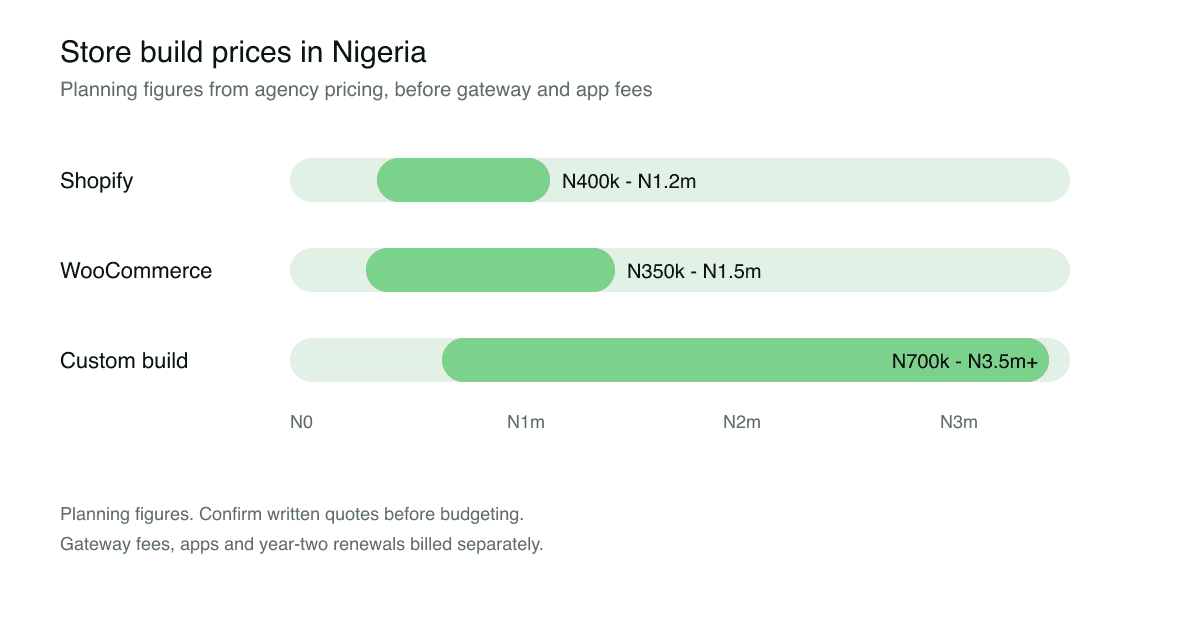
- Shopify store, configured and branded: about ₦400,000 to ₦1,200,000 for the build, plus the monthly platform plan and apps in dollars.
- WooCommerce store: roughly ₦350,000 to ₦1,500,000 for the build depending on design and extensions, plus hosting at about ₦22,000 to ₦100,000 a year for a modest catalogue.
- Custom store or marketplace: about ₦700,000 to ₦3,500,000 and up, and ₦2,000,000 to ₦10,000,000 plus if it is really a web application.
- Payment gateway fees, verified September 2026. Paystack charges 1.5 percent plus ₦100 on local transactions, capped at ₦2,000, with the ₦100 waived below ₦2,500, and settles the next business day. Flutterwave charges 2 percent locally, capped at ₦2,000, after increasing from 1.4 percent in April 2025, and 4.8 percent on international transactions. Nomba charges 1.4 percent capped at ₦1,800 and will negotiate volume discounts above ₦50 million a month. Monnify charges 1.5 percent capped at ₦2,000 and differentiates on instant settlement. Interswitch's WebPAY charges 1.5 percent capped at ₦2,000 but adds a one-time ₦150,000 setup fee, which is the line that pushes small businesses elsewhere. All of this is per BusinessDay's September 2026 comparison of seven Nigerian gateways, and rates change, so confirm with the provider before you build a margin model on it.
- Recurring every year: domain, hosting, SSL if you buy a paid certificate, gateway fees, and any apps or extensions you renew.
Year one is not the useful number. Year two, with subscriptions, renewals, maintenance and a developer on call, is the number that decides whether the store is a business or a hobby.
Pricing by catalogue size
Product count changes the work more than people expect.
- Under 50 products. Any route works. Upload the catalogue yourself, keep the design simple, and do not pay for a custom build.
- 50 to 100 products. Where most Nigerian stores live. Variations, stock levels and search start to matter. WooCommerce or Shopify both cope.
- 100 to 500 products. You need real filtering, search that works, and a stock system that updates. This is where cheap builds start failing and where hosting quality shows.
- 500 plus, or B2B pricing. Off-the-shelf platforms strain. Custom or a platform plus serious middleware is the honest answer.
Whatever the size, the deciding constraint is usually not the platform. It is whether one person can keep the catalogue accurate.
The delivery problem, which is bigger than the platform
Delivery is where Nigerian ecommerce margins actually go.
- Pay on delivery moves the risk to you. A refused parcel costs you the trip, the rider's time, and possibly a product that comes back damaged.
- Third-party logistics quotes per zone and per weight, and its tracking is often a phone call. Build your order screen around what you can actually see.
- Your own rider gives you control and does not scale past a certain volume without a dispatcher.
- Pickup only is underrated for a first store. It removes the delivery gamble while you learn what people order.
Whichever you choose, collect the right information at checkout: full address with a landmark, a phone number that actually answers, and a preferred delivery window. Most failed deliveries are bad data, not bad logistics.
Claim stock when the order lands, not after payment clears. During a sale a fast line can empty in minutes, and a figure someone updates at night will sell the same stock twice. The mechanics match our oversell rule for sales driven by agents: the claim must sit inside the transaction.
The logistics of trust
Nigerian buyers are cautious online, and the store has to answer that before the sale.
- Show a real address and a real phone number, not just a form.
- Show payment options clearly, including transfer details if you accept them.
- Publish a returns position in plain language, even if it is strict.
- Put reviews where they can be seen, and answer the hard ones.
- Make the WhatsApp button obvious. Many buyers will message before they buy, and a store that makes that hard loses them.
What actually breaks after launch
- Stock drift. The site says three left, the shelf has none. Fix the process, not the platform.
- Abandoned carts. People fill a cart, then get distracted. Reminders recover a share of it, and that is a workflow problem before it is a platform feature.
- Payment failures that nobody sees. A failed charge that is never followed up is lost revenue. Someone must own the failed-payment list.
- Slow mobile pages. Most Nigerian traffic is mobile. A heavy theme with five sliders will lose the sale before the product loads.
- Nobody updating it. A store with stale prices is worse than no store.
Which ecommerce platform should you choose?
- Testing a new product line and need to sell next week: Shopify.
- 50 to 500 products, a developer relationship, and you want to own the asset: WooCommerce.
- Your ordering rules are the business, or you sell B2B with credit terms: custom.
- Selling only to your WhatsApp contacts with no catalogue: you may not need a store yet. Fix the follow-up first, then build the store when the volume justifies it.
The moment that flips my answer is staffing. When you start onboarding assistants and the chat becomes the bottleneck, or when orders flow through several phone numbers and nobody knows which record is true, the store stops being overhead and starts being the shared record. That is when to build.
Where we come in
We build ecommerce stores and the order handling behind them, including the payment integration, the delivery workflow, and the follow-up that runs after checkout. For the pricing side, our cost guide covers what to expect from a Nigerian build, and our web development service is where the build itself sits. If you already know the catalogue size and the delivery model, talk to us and we will tell you which of the three routes is cheapest for your volume.
Work with us
We design, build and automate the software Nigerian businesses grow on.
Stay in the loop
Get the latest updates and insights delivered to your inbox.
More like this
Workflow Automation for Small Businesses: Where to Start
Where to start with workflow automation in a Nigerian small business, which processes to leave alone, what it costs to run, and the order that stops projects stalling.
Read ArticleCRM for Small Businesses That Still Run on Memory
If customer records live in your head, a notebook and WhatsApp, here is the simplest CRM for small business in Nigeria, what it costs, and when software is worth it.
Read Article