

An AI agent is software that goes after a goal on its own: it reads the message, checks the record, decides the next step, and takes it. A chatbot waits to be asked. An agent closes the loop. If you run a Nigerian business and you are trying it for the first time, do not start with the hardest job in the company. Start with the repetitive one that has a clear finish line.
What "agent" actually means, without the jargon
Most of what is sold as AI today is three different things wearing the same name.
- A chatbot answers a question. Ask it about delivery and it replies. It does not know whether your rider has left the shop.
- An automation follows a rule you wrote. When a form is submitted, send an email. It never changes its mind and it never handles a surprise.
- An agent decides the next step from a goal. It can check the stock sheet, see that an item is out, look up a similar product, and send the customer that option instead, then log what it did.
The difference matters because agents cost more to build and to run than either of the other two, and they fail in more interesting ways. A rule that breaks stops. An agent that breaks can keep going confidently in the wrong direction.
That is also why the two words are not interchangeable on a quote. Automation is a project with rules in it. An agent is the same project with judgement in it, and judgement needs a way to be checked. Anyone selling you an agent without guardrails and an escalation path is selling you a liability.
The inbox a wholesale business actually has
Take a wholesaler we work with in Iyanapaja. She supplies retailers across the country and sells through a Telegram channel of 56,000 followers. Retailers who already buy from her sit in that channel, and so do strangers who arrived through a link. Every day the same traffic comes in.
- A buyer who has never purchased asks the price of three items and whether she delivers to their state.
- A buyer who paid on Tuesday asks where the parcel is.
- A retailer sizing up an order asks what delivery to their area costs before they commit.
- A buyer who stock piled three items across two weeks asks when they can come and collect all of it in one trip to the park.
- Someone who found the channel through a link asks whether it is genuine.
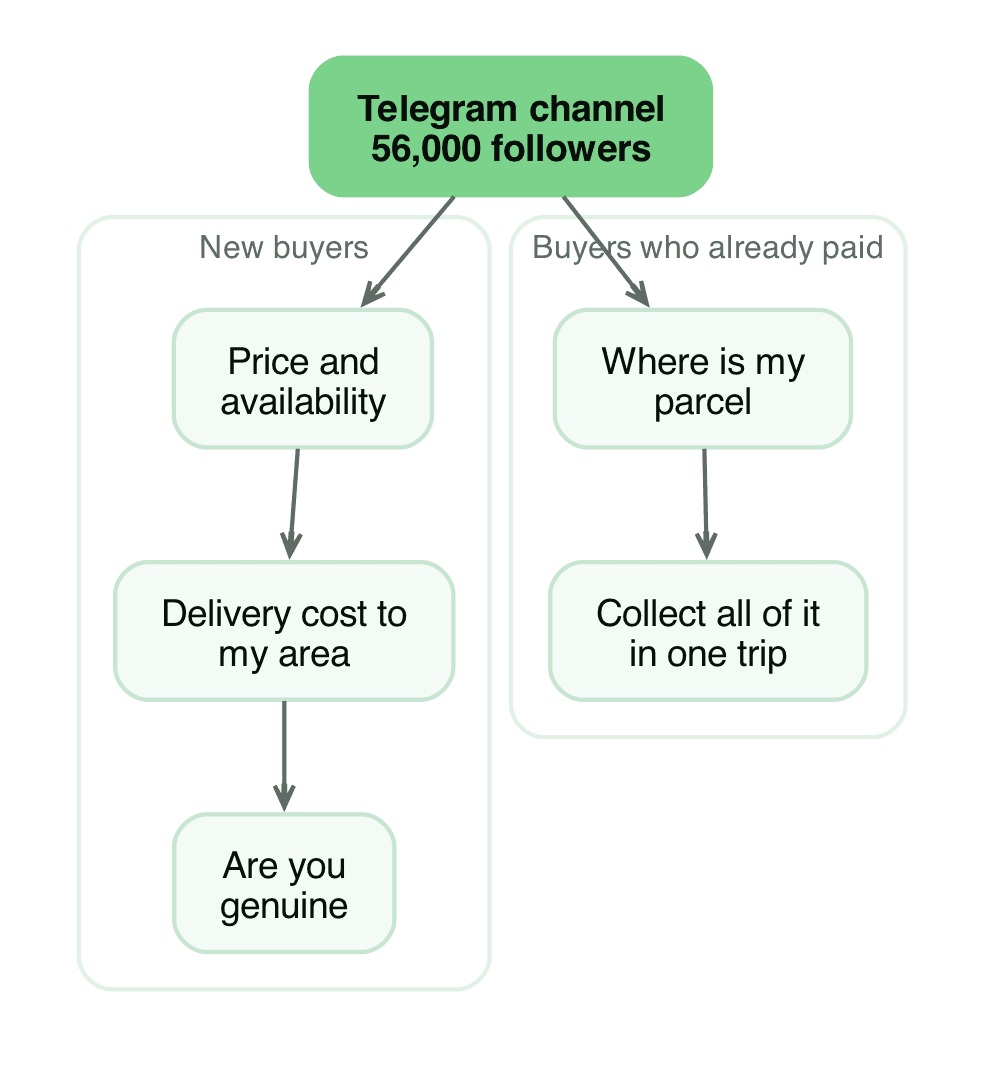
We reviewed more than 500 wholesale Telegram channels before building anything like this, and that list came back in every one of them. The details change by seller. The pattern does not.
Those messages group into five kinds of work.
Enquiry handling. Price, availability, delivery cost, and whether the channel is genuine. A channel with tens of thousands of followers produces this all day, and your own records answer it, which is what makes it a good first project.
Order status chasing. A buyer pays, and the parcel goes into a system the buyer cannot see. Nigerian intercity delivery is unreliable in a specific way: a carton sits at a motor park for a day, a rider goes quiet, a waybill number stops moving. The buyer has no way to check, so they message the seller. One unanswered status question becomes three messages, then a public comment under a post. Nothing is wrong with the business and the buyer is already annoyed. The seller is the only source of truth the buyer has, so every silent hour costs twice: once in the delayed delivery, and once in staff time spent answering the same question.
Stock piling. Some buyers are not waiting on you at all. They paid for three things on three different days and they want one trip to the park, because a waybill is charged for the trip and three journeys cost more than one. They keep asking when the whole pile is ready. Their money is in your account, their goods are on your floor, and the stock stays claimed the whole time.
Chasing the balance. Money has been sent but the reference has not arrived, the customer typed the wrong amount, or the transfer is sitting in the pending list. This is the money owing you, and most buyers pay it once the maket is good, so the chasing has a rhythm rather than being random. Someone still has to open the bank app, check, reply, and update a notebook.
Reconciliation and reporting. At month end, someone spends two nights rebuilding numbers from three platforms to answer one question: did we make money?
What to automate first: a scoring method you can run today
Pick five or six candidate tasks and score each from 1 to 5 on these four questions.
- Volume. How many times does this happen in a week? Under 20 is probably not worth building.
- Rule clarity. Could you write the steps on one page, including the exceptions? If two staff members disagree on the right answer, an agent will too.
- Cost of an error. If the agent gets it wrong, does a customer lose ₦2,000 or does a regulatory filing go bad? Start where the blast radius is small.
- Who is freed up. A task that eats a founder's day is worth more than a task that eats an idle hour.
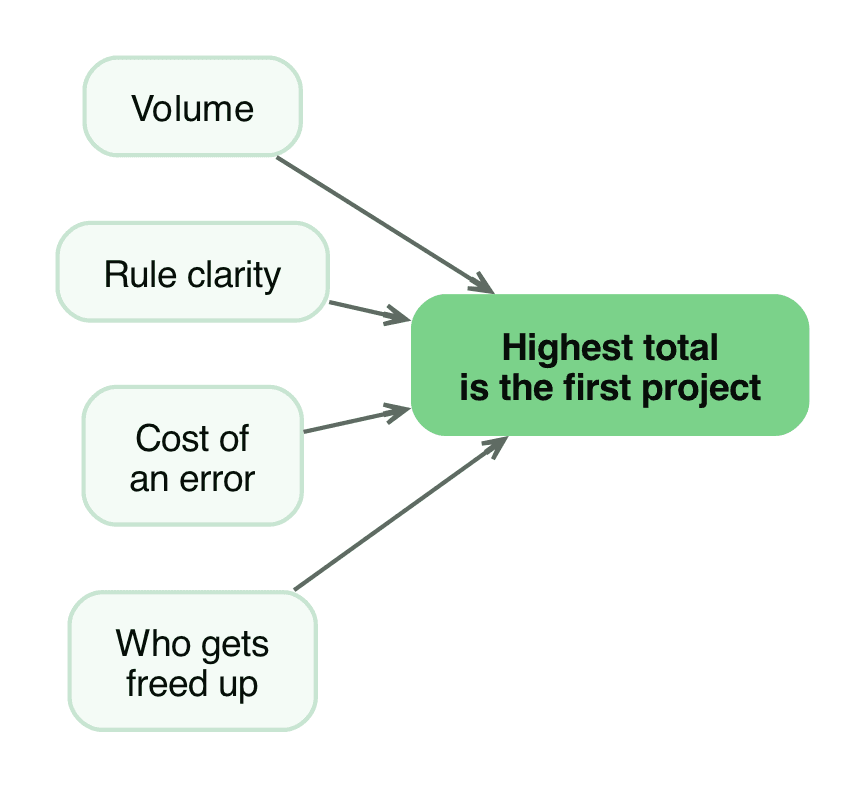
Add the scores. The highest total is your first project. In practice, for a Nigerian small business, the winner is almost always inbound enquiry handling with a human handover for anything involving money or a complaint.
Run the same scoring on that wholesaler's pile and the ranking becomes concrete. Enquiry handling scores 5 on volume and 5 on rule clarity, because the price sheet answers it. Quoting delivery cost scores high too, once the area, state and LGA sit in one table. Status chasing scores 5 on volume and lower on rule clarity, because "where is my order" is easy to answer when the rider has actually reported and impossible when he has not. Complaint handling scores low on rule clarity every time, so it stays human.
Run this scoring before you accept any proposal, including ours. If an agency cannot tell you why it picked your first workflow over your second, it is selling a demo, not a system.
Six agent projects that pay for themselves
These are the shapes we see working in this market. Each one starts small and can be extended later.
1. Enquiry handling
It reads incoming Telegram and WhatsApp messages plus channel comments. It answers price and availability from your live product sheet, and quotes delivery from a table keyed by area, state and LGA, including offloading, so the number matches what the rider will charge. It collects the buyer's details and hands over to a person when the message involves a complaint, a refund, a discount, or a custom order. The measurable win is response time. Nigerian buyers message three suppliers at once and buy from whoever replies first. In a channel that size, a first reply that lands in two minutes instead of three hours decides more sales than any other change you could make.
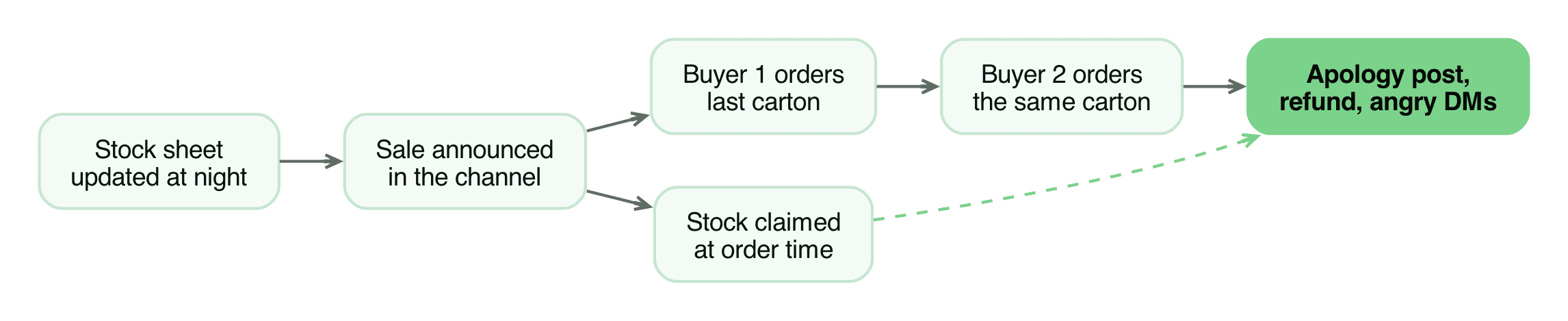
During a sale this job matters more, not less. A channel that size can empty a line in minutes, so availability has to come from stock claimed at the moment the order lands, not from a figure someone updates at night.
2. The payment-reference chaser
When an order is placed but no matching payment reference arrives within an hour, the agent sends one polite reminder with the exact amount and account. It escalates to a human after the second attempt, and it does not guess. It only states what it can verify against the payment record.
3. The dispatch coordinator
The agent takes the day's confirmed orders, groups them by area and LGA, drafts the rider manifest, sends each rider their list, and updates the order status when riders reply. Two riders go silent, so it follows up with a message and then flags both for a human. The buyer gets a status update without having to ask, and that is what stops the messages multiplying. The dispatcher stops being a message router and starts solving actual problems.
4. The document reader
Invoices, receipts, delivery notes and expense snaps get read, the fields get extracted, and the values land in the accounting sheet or ERP. This is often the highest return per naira because it removes an entire evening of typing and it is easy to audit, since every extracted field can be shown next to the original image.
5. The month-end reporter
Sales from the website, transfers from the bank, and expenses from the sheet are pulled together into one report that lands in the founder's inbox on the first working day. No new source of truth, just an assembly job that nobody enjoys.
6. The onboarding agent
New client documents are collected, the folder is created, access is provisioned, the kickoff is scheduled, and both sides get a checklist. This one matters most for agencies and professional services firms.
The pattern is the same every time: one painful process, a clear finish line, and a human holding the exception queue.
What it costs in Nigeria
There is no honest single price, so here are the shapes of the spend. What sits inside each one varies more than the headline.
- A focused single-workflow build. One process, one or two integrations, a human handover. This is the right starting point for most small businesses.
- A multi-workflow system. Two to four connected processes sharing one customer record. The cost is driven by integration, not by the AI.
- Ongoing running costs. Model usage, hosting, and the messaging platform. Model usage is usually small for text and can spike for voice. WhatsApp Business Platform message fees are separate and now metered per message, so estimate your volume with the WhatsApp pricing calculator before you commit.
- The integration tax. If your records live in a notebook, three WhatsApp chats, and a POS that has no export, a large part of the budget goes into getting your own data into one place. For a seller with a Telegram audience the same applies to two pieces of data that look boring. One is the delivery charge table by area, state and LGA. The other is some way to know what each rider actually did. Neither is AI work, and both are where the budget goes.
Be suspicious of a fixed price quoted before anyone has seen your data. The cost of an agent project is mostly the cost of the mess around it.
What it costs to work with us. The consultation is free, and that is where we work out what is actually leaking. A written plan of what to automate, in what order, is ₦30,000. A first build starts from about ₦564,000, and that number only means something against the leak the plan puts a figure on. If eSales already covers how you sell to your Telegram audience, we say so and price only what still needs building.
Where the timeline really goes
A realistic first project looks like this. One week to map the process and agree on the exception rules. One to two weeks to build against real messages and real records, not a demo dataset. One week of running it in shadow mode, where the agent drafts and a human approves, so you can count its mistakes. Then a switch-over, with the human queue still open.
For a wholesale channel, real messages mean the last two weeks of exported Telegram messages and comments, typos and all. That export is also the fastest way to see which questions you are paying someone to answer by hand every day.
If the business runs periodic sales, run the first live week during one. Message volume peaks exactly when nobody has time to answer by hand, and that is also when overselling shows itself.
Shadow mode is the part sellers skip and buyers regret. It is also where you learn the real exception list, which is never the one you wrote down in week one.
How to tell whether it worked
Agree on three numbers before the build starts, and write them down.
- First response time, in minutes, on the channel your customers actually use. For a Telegram seller that is the channel and its comments, not the email inbox.
- Touched-by-human rate. What share of conversations ended without an employee getting involved.
- Cost per resolved conversation, including the subscription, model usage and message fees.
If the first two improve and the third does not, you have bought speed rather than savings. That can still be a good trade, since a faster reply often wins the sale, but you should know which trade you made.
The failure modes, stated plainly
- An agent without good data is a confident guesser. If your price list is wrong, it will quote the wrong price all day, faster than before.
- An agent that sells what you do not have. Quoting availability from a stale figure, or decrementing stock after payment rather than at order, is how overselling starts. The buyer gets an apology and a refund, and the refund is handled in the same inbox you just automated.
- A stale shipping table is the same problem in disguise. If the table says one delivery cost and the rider charges another, the agent has created a dispute rather than an answer. Keep the table staff-editable and version it.
- The status you send is only as true as your rider feed. If the agent reports "delivered" because a manifest was marked complete, and the carton is still at the park, you have automated a lie. Status should come from a report, not from a field someone closed on Monday.
- Nigerian English and Pidgin still trip up voice systems. Text holds up better than a phone call. Test on your own customers' messages before you believe a demo.
- Payment disputes need a person. An agent that apologises and promises a refund it cannot authorise creates a second problem.
- Voice is expensive to run. Per-minute costs stack up quickly, and a phone number for Nigeria is not available on every platform. If a provider cannot give you a local number, your customers are paying to call a foreign one.
- Nobody owns the exceptions. Every agent project produces an exception queue. If no one is assigned to it, the queue becomes next year's mess.
- Agents drift. Models change, platforms change their rules, your catalogue changes. An agent that worked in October can quietly degrade by January without anyone editing it.
When not to buy this
Do not start an agent project if the underlying process changes every month, if you cannot name the person who will own it, or if your real problem is that you have no repeat customers. Automation multiplies a working process. It does not repair a broken one.
If your issue is that customer records are scattered across a notebook, WhatsApp and one phone, fix the record first. That is a smaller, cheaper problem and it makes everything after it possible. If your messages are already answered well and your bottleneck is elsewhere, say so and keep your money.
Where we come in
We build these systems for Nigerian businesses, and we start with the same scoring exercise above rather than a product demo. If you want to see the six areas we automate most often and what a build looks like, start with our AI automation agency page.
If you already know the workflow you want fixed, talk to us and bring the messy version.
Work with us
We design, build and automate the software Nigerian businesses grow on.
Stay in the loop
Get the latest updates and insights delivered to your inbox.
More like this
AI Receptionist in Nigeria: Costs, and When to Hire a Human Instead
What an AI receptionist costs to run in Nigeria in 2026, why the accent objection no longer applies, and the point where a human at minimum wage is the better buy.
Read ArticleWhat Is an AI Agent? Types, Builders and Business Examples
An AI agent plans, uses tools and checks its own work to finish a task. Here are the types, the builders worth trying, and where agents fail in real businesses.
Read Article