

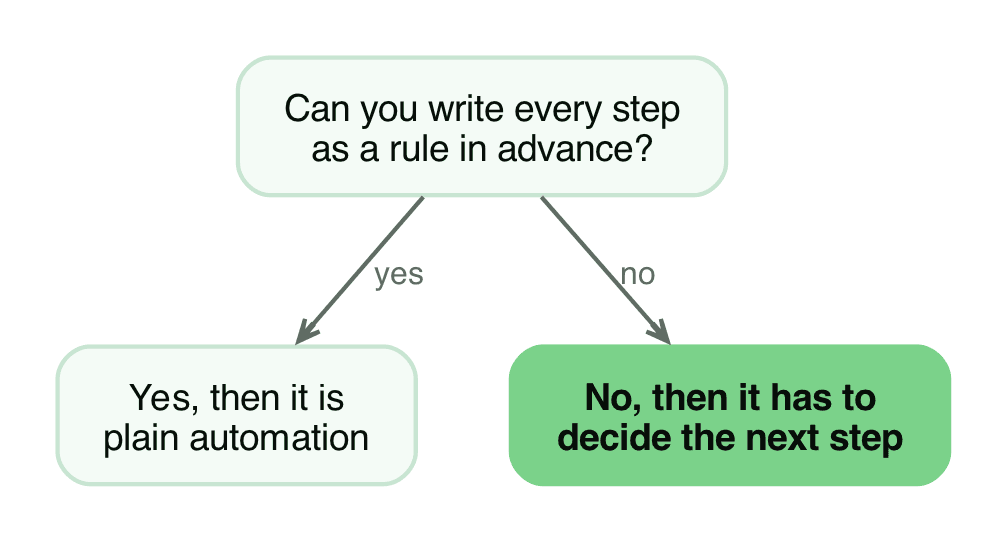
An AI agent is a system that takes a goal, works out the steps on its own, uses tools to carry them out, and checks whether the result actually got there. The clearest test is simple: if you can write every step as a rule in advance, you have automation. If the system has to decide the next step because the input is unpredictable, you have an agent.
That distinction decides what you should buy. It also explains why so many agent projects stall after the demo. The impressive part is the reasoning. The hard part is everything around it.
Agent, chatbot, automation: the difference that matters
Three products get sold under the same name.
- A chatbot answers. You ask about delivery, it replies with your delivery policy. It has no idea whether the order shipped.
- An automation follows a rule. A form is submitted, a row is added, a receipt is emailed. It never surprises you and never handles a surprise.
- An agent pursues a goal. Give it "get this order delivered" and it can check stock, confirm payment, pick a rider, send the details, follow up when the rider goes quiet, and flag the one order that needs a human.
Put another way: a chatbot produces text, an automation produces a state change, an agent produces an outcome. Most businesses need a mix, and the agent is usually the smallest part of a working system.
The parts of an agent
Strip away the marketing and every agent has the same five pieces.
- A goal. Stated clearly enough that success is checkable. "Reduce unpaid invoices" is a goal. "Be helpful" is a wish.
- A planner. The model decides the next action. This is the part people call the agent.
- Tools. The things it can actually touch: a database, a spreadsheet, a payment API, a calendar, a WhatsApp number, a browser, a Telegram channel. No tools, no agent, just a talker.
- Memory. What it knows about this customer or this case, and what it learned from the last twenty runs.
- Guardrails. Spending limits, approval thresholds, forbidden actions, and a human escalation path.
Beginners obsess over the planner. Production systems live or die on tools and guardrails. An agent with a brilliant model and a read-only database is a research assistant, while an agent with a modest model and tight, well-instrumented tools ships value.
Types of agents, in plain terms
The categories below come from how the system is built, not from marketing labels. You will meet all of them if you shop for this seriously.
- Reflex agents. React to a trigger with a fixed response, with a model reading the input. The enquiry bot that answers price and availability. Cheapest, most reliable, easiest to audit.
- Tool-using agents. Plan a short sequence and call real systems: look up an order, create a ticket, send a message. Where most business value sits today.
- Multi-step or workflow agents. Handle a process end to end over hours or days, including waiting for a human or a payment to arrive.
- Multi-agent systems. Several agents with different roles passing work between them. Useful for research and content pipelines, expensive and hard to debug. Rarely the right first project for a small business.
- Autonomous coding agents. Read a codebase, edit files, run tests, open a pull request. Powerful for engineering teams, irrelevant to a retail business.
- Voice agents. Talk on a phone call in real time. The hardest to get right, the most expensive to run, and the most sensitive to accents and background noise.
If a vendor cannot tell you which category their product is, ask what happens when the model returns something unexpected. The answer will tell you more than the feature list.
What agents do in real businesses
The pattern in every working case is the same: a repetitive decision, a checkable outcome, and a human available for the exceptions.
- Order enquiry handling. Read the message in a Telegram channel, identify the product, and confirm price and stock. Quote the delivery charge for the buyer's area, and push anything about a refund or a complaint to a person.
- Order status updates. Tell a buyer who already paid where their parcel is, from the latest rider report, without waiting to be asked.
- Collections follow-up. Notice an unpaid invoice, send a correctly worded reminder at the right interval, log every attempt, and stop immediately when a payment lands.
- Document processing. Extract fields from invoices, receipts and delivery notes, validate them against records, and route anything that fails validation to a human.
- Onboarding and provisioning. Collect documents, create accounts, schedule the kickoff, and chase outstanding items on a schedule.
- Research and monitoring. Watch competitor prices, tender portals, or news mentions and produce a short daily brief. Useful, low risk, easy to verify.
- Internal triage. Read incoming support or sales messages, categorise them, assign an owner, and set a deadline.
Notice that none of these need the agent to be creative. They need it to be consistent and to know when to stop.
The delivery loop, in full
The clearest agent job in Nigerian commerce is not answering a question. It is getting a paid order to the buyer. Here is the honest version of that loop, written for a wholesale business that sells to retailers across the country.
The goal is: get this order to Surulere. The agent's steps look like this.
- Read the order and check that the payment reference matches the amount paid.
- Look up the buyer's area and state, and read the delivery charge for that route from the table.
- Claim stock for the line items as part of the order, and flag the order if anything is short rather than selling air.
- Pick the rider or carrier for that route and add the order to the manifest.
- Tell the buyer the order has moved, with the date and the carrier, so nobody has to ask.
- Wait for the rider's report. Six hours of silence means a follow-up to the rider, not a silence passed on to the buyer.
- Twelve hours still means nothing, so a human picks the order up and calls somebody.

Step 3 is where overselling is prevented or caused. Stock read from a figure that updates on a schedule is already wrong by the time the message is answered. The agent has to claim stock as part of the order, or it sells goods that went twenty minutes ago. The buyer gets an apology and a refund, and the refund arrives in the inbox the agent was meant to empty. A paid order nobody has collected also keeps its claim. Buyers order across a week, then want one trip to the park, because a waybill is charged for the trip and one journey costs less than three. The agent needs a written rule for how long to hold those orders, when to nudge the buyer, and when to put the stock back in the pool. Without that rule the shop fills up with boxes nobody has come for, and a sale announcement sells the same stock twice.
Step 6 is where the value is. The seller has no live feed of what the carrier did, so the rider goes quiet and the buyer is left waiting with no information. An agent that chases the rider when he goes quiet turns a silent failure into a phone call. Two limits apply. The agent cannot invent a delivery date, because the parcel really does sit at a motor park some days. A promise it cannot keep costs more than a late answer. It also cannot report a delivery it did not see, so the status it sends should come from a rider report or a carrier scan, not from a manifest someone closed on Monday.
AI agent builders worth knowing
You do not have to build from scratch. These are the main routes, from least to most control.
- Hosted agent builders. Point-and-click systems where you define instructions, attach tools and publish. Fastest path, least control, and your data lives with the vendor.
- Workflow platforms with AI steps. n8n, Make and similar tools let you wire models into a real process with retries and error handling. This is where most agency work happens, and it is the best balance for a small business.
- Developer frameworks. Code-first libraries for teams that need custom tools, evaluation and deployment control. More work upfront, far more debuggable at scale.
- Local model stacks. Running a model on your own machine for privacy or cost reasons. Practical for development work, rarely the right call for customer-facing systems that must be available at 7am.
The honest ranking for a Nigerian small business is: workflow platform first, hosted builder if the process is simple, custom code only when the volumes or the data rules demand it.
How to build one, in order
- Write the job down. Trigger, steps, exceptions, done. If you cannot do this, you are not ready to build.
- Collect real examples. Export a week of channel messages and rider reports. Fifty real messages beat any specification, because they reveal the exceptions you forgot.
- Pick the tools before the model. What must the agent read? What may it write? Where does a human approve?
- Start in shadow mode. The agent drafts, a person approves. Count its mistakes for a week or two.
- Add guardrails. Spending caps, no irreversible actions without approval, and a hard stop after N failed attempts.
- Instrument it. Log every run. Track how often a human had to take over. Without logs you are guessing.
- Review monthly. Models change, platforms change their rules, and your catalogue changes.
Where agents fail
- Confident wrongness. A model that misreads a price will repeat the error all day. Every money-touching action needs a check.
- Selling what you do not have. An availability answer taken from a stock read that was true an hour ago is an oversell. Claim stock inside the transaction, cap what one buyer can order of a fast-moving line, and close the line when it is gone.
- A delivery charge that no longer applies. The table is the agent's source of truth, so a stale route price becomes a wrong quote at scale. Put an owner and a date on it.
- The status that was never true. If the agent reads "delivered" from a field a human closes to tidy the sheet, the buyer has been told something untrue. Read reports, not intentions.
- Tool debt. Each integration is a thing that can break. Ten tools means ten failure points, and one silently dead API can make the agent look broken.
- Prompt fragility. Small changes in customer wording can move a well-tested flow outside its happy path. Test with real messages, not tidy examples.
- Cost drift. Text is cheap, voice is not, and long conversations with large context get expensive quickly.
- Evaluation debt. Teams ship without a test set, then cannot tell whether a change made things better or worse.
- Accent and dialect. Voice agents still struggle with Nigerian English and Pidgin in noisy conditions. Text first, voice when you can prove it on your own callers.
- Ownership vacuum. Agents produce exceptions. Someone has to own the queue.
When an agent is the wrong answer
Choose plain automation when the steps never vary. Choose a human when the interaction is the product, such as negotiating a large contract or handling an angry customer who needs to feel heard.
Choose to fix your data first if your records are spread across a notebook, three chats and a phone. An agent cannot reason its way out of missing information, and a CRM for a small business that runs on memory is the cheaper first project.
And if your real problem is that you do not have enough customers, agents will simply help you process fewer of them, faster.
Trying it without betting the business
Pick one enquiry type that repeats daily and has a verifiable answer. Build only that. Run it in shadow mode for two weeks alongside your normal process. Measure three things: how much faster the first reply went out, what share of conversations finished without a person, and what the whole thing cost to run.
If those numbers hold, extend the same setup to the next workflow. If they do not, you have spent a fortnight learning something useful instead of a year learning it the hard way.
When you are ready to look at what this means for a Nigerian business, including the workflows worth starting with and the costs in naira, our AI automation practice covers the same ground with local context.
Work with us
We design, build and automate the software Nigerian businesses grow on.
Stay in the loop
Get the latest updates and insights delivered to your inbox.
More like this
AI Receptionist in Nigeria: Costs, and When to Hire a Human Instead
What an AI receptionist costs to run in Nigeria in 2026, why the accent objection no longer applies, and the point where a human at minimum wage is the better buy.
Read ArticleWhat Is AI Automation? A Beginner Guide With Nigerian Examples
AI automation is software that runs a whole business process, decisions included. Here is how it works, what it costs in Nigeria, and where to start.
Read Article