
AI automation is when software takes over a whole business process, including the small decisions inside it, instead of just one step. Ordinary automation moves data when a rule matches. AI automation can read a messy message, work out what the customer wants, and decide the next action. You do not need to write code to use it, but you do need to understand it well enough to buy it.
YouTube automation, and what automation actually means
The phrase means two different things in Nigeria. One of them is not what this guide is about, but it is worth explaining properly, because the name is doing a lot of work it has not earned.
What YouTube automation is. Running a channel without appearing on camera: stock footage, a voiceover, and editing you outsource to a freelancer or run through a tool. The pitch is that the channel publishes on its own and earns from ads while you never show your face. Money comes from three places, watch page and Shorts ads through the YouTube Partner Program, affiliate links, and sponsorship once the channel is big enough for a brand to care.
The numbers nobody quotes properly. The Partner Program threshold is 1,000 subscribers with 4,000 qualified watch hours in the last 12 months, or 10 million qualified Shorts views in the last 90 days (YouTube's own eligibility rules). Every channel that clears it goes into a review queue before any money is paid. You will see ads on your channel before you are eligible and receive none of that revenue. So the honest version of the pitch is months of unpaid work, followed by a rate you do not control and nobody will quote you fairly.
Why the name is wrong. You still make every decision. You pick the niche, decide what each video argues, write or approve the script, approve the voiceover, judge the thumbnail, and decide when a video gets pushed. Software records the screen and schedules the upload. That is a production assistant, not automation. Calling it automation is a marketing gimmick, and it is sold next to income figures that came off somebody else's channel.
The AI in it is optional. A voiceover tool and a stock library will make a video for you, but neither chooses the niche, judges the angle, nor tells you whether the numbers work. Remove the AI and the channel survives, because the part doing the thinking was never the AI. It was you.
Automation has a test, and it is simple: does the software decide the next step from a goal you set, or are you still deciding and calling it automation? YouTube automation fails it. Everything else in this guide passes it.
A workflow is simply the order those steps happen in, so workflow automation means the same thing as business process automation. The word is accurate and also vague, because almost any piece of work is a workflow.
The next section applies the same test to the software itself, and the difference between a chatbot, a fixed rule and an agent comes straight out of it.
The difference between automation and AI automation
A fixed menu breaks on the second message. A retailer types "how much be this one" under a photo of a product nobody in the shop recognises by name. The next one is a voice note. Then a buyer pastes your price list back at you with a single line circled. Then someone two states away asks what delivery costs to their town, in four words.
Plain automation can reply with a fixed menu when a message arrives. It never reads what the person wrote, so it answers the wrong question or repeats the menu until the person gives up.
AI automation can read each message. It works out what is being asked, pulls the price from the live sheet, and checks the stock level. It reads the order record and the latest rider report, then quotes the delivery charge for that buyer's own area. When a message is about a refund, a discount or a missing parcel, it hands the whole conversation to a person instead.
Both are automated. Only the second one understood the message.
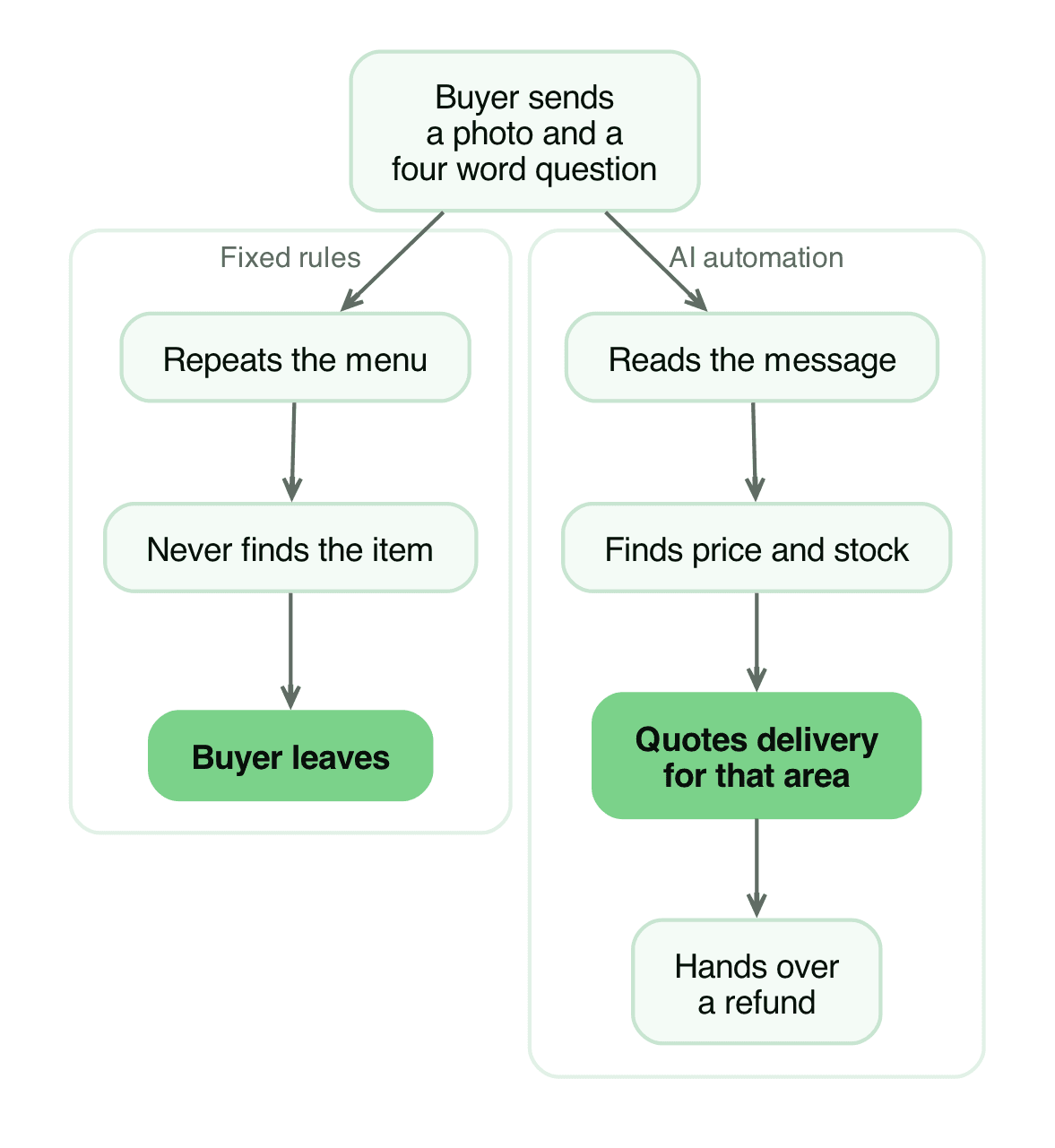
The practical difference shows up quickly. A fixed menu handles a predictable customer. A real customer types one line, then sends a photo, then asks for a carton price, then asks whether the goods are original. The rules-based system runs out of answers after step one, while the AI system keeps going and hands the conversation to a person when it should.
Four lines separate them. A rules-based system reads fields and triggers; AI reads free text, images and voice. When the input varies, rules break or misroute, while AI adapts inside limits. Setup is different too: with rules you define every branch by hand, with AI you define the goal and the guardrails. And the failure modes are opposites. Rules stop quietly. AI can be confidently wrong.
That last point is the part nobody puts in the brochure, and it is the reason testing matters more than the tool you choose.
How it works under the hood
You do not need the plumbing, but the shape of the machine explains its limits.
- A trigger fires. A message arrives, an invoice is uploaded, a form is submitted, a row changes in a spreadsheet.
- The system gathers context. It pulls the relevant records: the customer, the price list, the order history, the stock level, the delivery charge for that area.
- A model interprets. It reads the text or image and produces a structured answer. This is the AI part.
- The workflow acts. It replies, creates a record, sends a reminder, updates a status, or escalates to a human.
- Something checks the result. This is the step that separates a system from a stunt. It could be a human approving anything involving money, or an automatic rule that flags low-confidence answers.
Most failed projects are missing steps two and five. They have a clever model and no context, or a working flow and no check.

A worked example: one wholesale channel
This is the shape we build most often for Nigerian sellers, so here is the whole thing on one page. Two kinds of message arrive in that channel all day. New buyers want prices, availability, delivery cost and proof that the channel is genuine. Existing buyers want to know where their parcel is, or when the items they paid for will be ready for one trip. The second question comes from the same place as the first, since delivery between states is unreliable and the buyer cannot see the rider's side of it. One system answers both.
- Trigger. A message or channel comment arrives from a buyer.
- Context. The system reads three things: the live stock and price sheet, the order record for that buyer, and the delivery charge table keyed by area, state and LGA.
- Interpretation. The model works out which question this is: price, availability, delivery cost, or order status. It identifies the product the buyer means, including local spelling and shorthand, and it checks whether that person has an open order.
- Action. Price and availability get answered from the sheet. Delivery gets quoted from the table for the buyer's own area and state. Order status gets read from the order record plus the latest rider report, and sent with a date rather than a vague "it is on the way".
- Check. Anything about a discount, a refund, a missing parcel, or a custom order is tagged and routed to a human queue with the conversation attached.
The delivery table is the part people skip, and it is the part that decides whether the system can answer at all. It is data entry: area, state, LGA, and what each carrier charges. Without it the system either guesses a delivery cost or refuses to answer, and both lose the sale. That is the honest shape of every AI automation project. The model is the small part. The records you already own are the project.
Sales are the case to design for from the start. A channel that size can empty a line in minutes, so an availability answer read from a stock figure that updates on a schedule is an oversell waiting to happen. Stock has to be claimed when the order lands, not when a sheet gets updated that night. Get that wrong and the business ends up with the problem it was trying to remove: refunds, apology posts, and more messages than the day before.
A paid order nobody has collected keeps its claim, which is stock piling from the seller's side. The goods are paid for, they are on the floor, and the cash has already gone. A buyer gathering three items for one trip to the park holds stock that a sale announcement will happily sell again.
The order status side works the same way. The system can only tell a buyer what a rider actually reported. A channel owner who wants this working needs a record of dispatch rather than a memory of who left with what. Some sellers start with eSales for that reason. It lives inside Telegram as a mini app, so a buyer orders, pays and checks their order in the same chat they found you in. Nothing to install, no website to visit. It sends the notification when the order changes state, and it claims stock when the order lands so a sale period cannot oversell. It is in beta for Nigeria right now.
What AI automation can do in a small business
These are the areas where it pays for itself fastest, roughly in order of effort.
- Customer enquiries. Price, availability, delivery areas, opening hours, order status, and the rest of the repetitive traffic in your inbox.
- Follow-up. Quotation sent and no reply, payment promised and not made, cart abandoned, appointment tomorrow. Each one gets a timed nudge.
- Document handling. Receipts, invoices, delivery notes and expense photos get read and turned into rows in a ledger instead of evening typing.
- Reporting. Sales, expenses and stock pulled from three places into one monthly summary that lands on the first working day.
- Internal routing. Approvals, leave requests and task assignment moved out of WhatsApp groups and into a workflow with a status.
- Onboarding. New customers or staff get documents collected, accounts set up, and checklists issued without someone chasing five people.
Notice that none of these are "AI" in the interesting sense. They are boring processes with a model in the middle.
Does it require coding?
For a business owner, no. You are buying an outcome, not writing software. But the honest version has four levels.
- No code, off the shelf. Tools like Zapier, Make or Power Automate connect apps with clicks. Good for simple flows. The ceiling arrives quickly when your data is messy.
- No code with a workbench. Tools like n8n let a technical person build more complex flows, including AI steps. Most agency work happens here.
- Low code. A developer writes the glue: webhooks, database queries, retries, error handling. This is where reliability gets designed in.
- Custom build. The process is specific to your business, or the volumes justify owning the system rather than renting four subscriptions.
Most Nigerian small businesses land between the second and third level. Someone on the team can read a spreadsheet and follow a checklist, and a developer handles the parts that must not fail.
What it costs
There is no honest flat price. There are four cost lines, and only one of them is the AI.
- Build cost. One workflow, two or three integrations and a human handover is the sane first project. Multi-process systems cost more because of the integration work, not the model.
- Platform subscriptions. Billed in dollars on most tools, which matters when your revenue is in naira. Check the renewal date and the currency before you sign.
- Usage. Text model calls are cheap and predictable. Voice minutes are not. WhatsApp Business Platform messages are now metered per message, so a busy inbox has a real monthly bill attached. Estimate it with the WhatsApp pricing calculator before you pick a channel.
- Maintenance. Prices change, catalogues change, platforms change their rules and their APIs. A system with nobody maintaining it decays quietly.
Five things people get wrong
- They automate a broken process. If two staff members answer the same question differently, the automation will too, faster and in writing.
- They start with the hardest case. A first project should be boring and verifiable, not the negotiation that closes your biggest client.
- They buy a tool before mapping the workflow. The tool is the last decision, not the first.
- They skip the human queue. Every automated system produces exceptions. Someone must own them.
- They measure nothing. If you cannot say what improved, you cannot defend the spend. Response time, human-touch rate and cost per resolved conversation are good starting numbers.
Where to learn it for free
If you want to understand the field before hiring anyone, these are the useful free routes. Search terms and course listings change constantly, so treat the list as a starting point.
- Vendor documentation and free tiers, especially n8n, Make and Zapier. Building one real flow teaches more than a playlist.
- YouTube walkthroughs for the specific tool you plan to use. Prefer recent videos, since interfaces change every few months.
- Community forums and WhatsApp or Telegram groups for automation builders. This is where the practical limits get discussed honestly.
- Your own data. Export a week of channel messages and DMs and read them. The repeated questions in that file are your first automation, and no course will tell you what they are.
The most in-demand skill in this field is not prompt writing. It is process mapping: sitting with a business owner, writing down what actually happens, and finding the step that should not involve a person.
What is changing in 2026
Two shifts are worth tracking. First, agents are replacing single-shot automations for processes with several steps, which moves the work from "connect these two apps" to "define the goal and the guardrails". What is an AI agent covers where that line sits. Second, voice is becoming practical, but a local Nigerian phone number is still not available on every platform, and per-minute costs stack up. Text remains the cheapest reliable entry point, and it is where a small business should start.
Where to start on Monday
Pick one process. Write down the trigger, the steps, and what a good result looks like. Count how many times a week it happens. Then answer one question honestly: if this task vanished tomorrow, who would you put on something better?
If you want a second opinion on which process to pick, see how we approach AI automation for Nigerian businesses. We start with the process you already run, not with a demo.
Work with us
We design, build and automate the software Nigerian businesses grow on.
Stay in the loop
Get the latest updates and insights delivered to your inbox.
More like this
AI Receptionist in Nigeria: Costs, and When to Hire a Human Instead
What an AI receptionist costs to run in Nigeria in 2026, why the accent objection no longer applies, and the point where a human at minimum wage is the better buy.
Read ArticleWhat Is an AI Agent? Types, Builders and Business Examples
An AI agent plans, uses tools and checks its own work to finish a task. Here are the types, the builders worth trying, and where agents fail in real businesses.
Read Article