
A CRM is a system that keeps every customer, what they asked for, what you promised, and what happens next, in one place that survives your memory. For a one-person business in Nigeria the honest first step is not software. It is a single customer list with five columns, kept somewhere you will actually update. Software comes later, when the list outgrows your ability to remember it.
Most owners who search for this are not looking for enterprise software. They are looking for the customer who asked for a price last Tuesday and never got a reply.
A wholesaler we work with in Iyanapaja sells to retailers through a Telegram channel of 56,000 followers. Before building for sellers like her, we reviewed more than 500 wholesale channels, and the same enquiry pattern came back in every one. The sheet below is designed for that traffic: fast questions, repeated daily, answered from records. The pattern behind it is written up in our field notes on AI agents for Nigerian businesses.
The three stages of customer records
Almost every small business sits in one of these, and the move between them is a decision rather than a purchase.
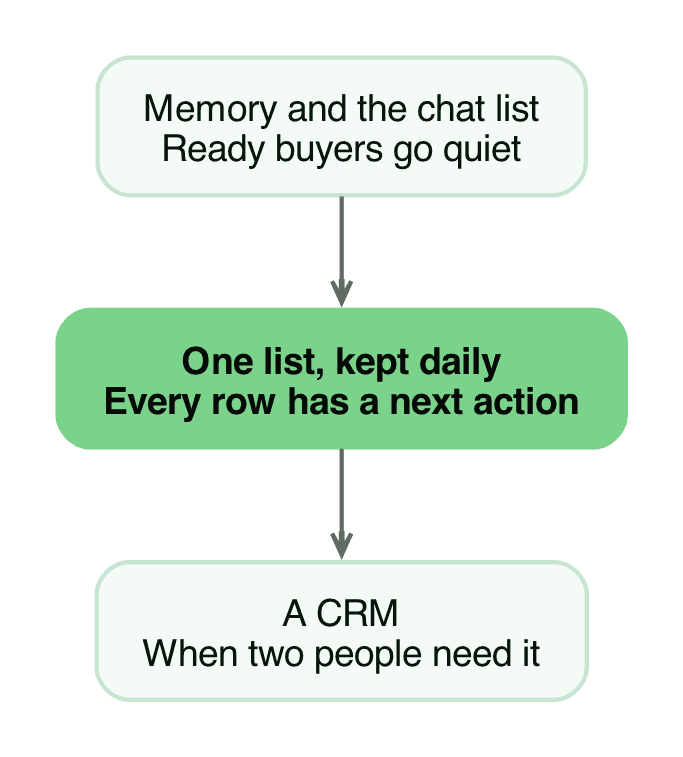
Stage 1: memory and the chat list. You know your regulars. The rest are somewhere in a WhatsApp inbox or a call log. The system works until volume grows, and then it fails in a specific way: the customer who was ready to buy simply never hears from you again, and neither of you notices.
Stage 2: one list, disciplined. A single sheet with the customer's name, contact, what they wanted, the last thing that happened, and the next action with a date. It is unglamorous and it captures most of the value of expensive software, because the value was never the software. It was the reminder.
Stage 3: a CRM. Software that holds the same information, adds reminders, logs every conversation in one place, and lets a second person pick up a customer without asking you questions.
The mistake is jumping from stage 1 to stage 3 because a vendor demo looked impressive. Buy the system before your process exists and you have paid for a database nobody updates.
What the single sheet needs, and nothing more
Five columns, one row per customer or enquiry. If you build this today, you are ahead of most of your competitors.
- Name and how they reach you. Phone and WhatsApp, plus the channel they first came through.
- What they wanted. The actual product or service, in their words. This is what future follow-ups are about.
- The last thing that happened. A quote sent, a sample delivered, a complaint, a promise to pay Friday.
- The next action and its date. Every open row must have one. This is the column that makes the system work.
- Status. New, quoted, won, lost, dormant. Everything else is detail.

Two rules make it survive. Update it after every meaningful conversation, not at the end of the week. And review the open rows every morning, not the whole sheet.
Excel or Google Sheets is enough for this stage. A phone number and a sheet beats a monthly subscription you do not open.
My own version of this was Apple Notes and the Reminders app on my iPhone when Team Darphiz was one person. The move to Notion came when the team grew and collaboration started, not before. Buy the tool at the collaboration point, not at the idea point.
When does a small business need a CRM?
Move from the sheet to software when one of these is true.
- More than one person talks to customers. Shared records stop the "who spoke to this person" conversation.
- You cannot see what is about to be forgotten without reading every row.
- Follow-ups depend on someone remembering. A CRM's whole job is to make the reminder automatic.
- You lose a customer and cannot say why. A CRM gives you a history to read.
- You want to know which source actually brings buyers. The sheet can do this too, but software does it without effort.
We are often asked to fix the annoying problem first. One founder came to us about delivery disputes eating his week while unanswered enquiries and abandoned orders sat in his inbox, unnoticed from where he sat. The inbox was the expensive problem. Run that diagnostic before you buy: find where money quietly leaves, then decide whether software is the fix.
If none of those is true yet, spend the money on something else. A CRM in a business with no repeat customers is an expensive address book.
What it costs in Nigeria
- Free tiers. Several platforms offer a free plan for a single user or a small contact limit. They are genuinely usable to start, and they have limits that will arrive: contact caps, no automation, no reporting, one user, or your data trapped in a tool you cannot export from cleanly.
- Paid small-business plans. Billed in dollars, usually per user per month, and the price steps up when you add automation or a second seat. Two users plus automation moves you out of the cheap tier.
- Naira-billed local options. A few Nigerian tools and accounting suites include light customer management. Cheaper in naira and less capable. If your need is a shared list and reminders, this can be enough.
- The setup cost, which people forget. Software is the easy part. Deciding the columns, importing your contacts, and training two staff takes real time, and that is what most failed rollouts actually ran out of.
- The hidden cost of not choosing. Two of your staff keeping two different lists is worse than one sheet, because now nobody knows which is true.
Whatever you pick, export your data before you commit. A CRM you cannot leave is a subscription you can never cancel.
Choosing between them without a demo marathon
Ask four questions of any tool, including a free one.
- Can I export everything, contacts and history, at any time? If not, stop there.
- Does it bill in dollars? At a volatile exchange rate this matters more than the headline price. Say your planned rate out loud before you subscribe.
- Does it speak to what I already use? WhatsApp, your email, your accounting sheet. A CRM that does not connect to where conversations happen becomes a second inbox you ignore.
- Will two people actually use it? Software adopted by one person is a personal notebook with a subscription. Adoption is the whole risk.
Then run it for a month with real customers before you pay for a year.
WhatsApp is not a CRM, and it is not the enemy
Your customers are in WhatsApp. That is a fact, not a problem to fix. The issue is that WhatsApp shows you a conversation, not a pipeline.
The workable arrangement is:
- WhatsApp for the conversation. It is where the buyer is, and it is fast.
- The list for the state. Who has been quoted, who owes money, who is waiting on delivery.
- A reminder for the follow-up. Quotation sent, no response after three days, gentle nudge. Payment promised, not received, reminder the next morning.
If your messages already cost money per message, because you are on the WhatsApp Business Platform, then a list that stops you sending five messages where one would do also saves real naira. That is a rarer argument for tidiness than anyone expects.
What to do this week
- Build the sheet today. Five columns, one row per open enquiry. Do not clean up your whole customer history first. Start with what is open.
- Set the next-action rule. No row without a next action and a date. Enforce it for one week and it becomes a habit.
- Write three follow-up messages. One for a quote with no reply, one for a promised payment, one for a customer who has gone quiet. Keep them short and human.
- Review every morning for ten minutes. Only the open rows.
- Then decide about software, once you know how many rows you are managing and how often the next action is missed.
The order matters. Process first, then software. The reverse is how people end up with a subscription and the same problem.
Where a system starts paying
If you are already past the sheet stage, the useful build is not the CRM itself. It is the automation around it: the quotation that triggers a follow-up sequence, the payment that closes a record and sends a receipt, the reminder that goes out two hours before an appointment, and a daily list of what is about to be forgotten. That is the part that turns a database into money.
We set these up for Nigerian businesses alongside the rest of the automation work, starting with the customer record rather than the tool. See the areas we automate or bring us your current sheet and inbox and we will tell you what to fix first. If you only want the starting template, the simplest customer record for a one-person business builds one from scratch.
Work with us
We design, build and automate the software Nigerian businesses grow on.
Stay in the loop
Get the latest updates and insights delivered to your inbox.
More like this
Workflow Automation for Small Businesses: Where to Start
Where to start with workflow automation in a Nigerian small business, which processes to leave alone, what it costs to run, and the order that stops projects stalling.
Read ArticleEcommerce Websites in Nigeria: Shopify vs WooCommerce vs Custom
What each ecommerce route costs in naira in 2026, what Paystack and Flutterwave take, what delivery really does to your margin, and which one fits your volume.
Read Article