
A website in Nigeria in 2026 costs about ₦150,000 for a one-page site, ₦200,000 to ₦2,000,000 for a business website, and ₦800,000 to ₦3,000,000 or more for an online store. Two agencies can quote the same figure for the same brief and deliver very different value.
Last verified: 3 October 2026
The reason is simple. What moves a Nigerian quote is the design, and then what the developer says is included, and the longer list of what they leave out. Two quotes can both read ₦450,000 and mean completely different projects.
The naira has made that gap worse. Hosting, domains and paid tools are priced in dollars, so a quote from last year is not one you can rely on. This guide gives you the 2026 ranges, then the part the other cost guides skip: how to read what is inside the number.
What a website actually costs in Nigeria in 2026
These ranges are drawn from Nigerian agency pricing published through2026 and from price calculators built on provider data. They move with scope.
- Landing page or one-page site: ₦150,000 to ₦300,000.
- Brochure site, three to five pages: ₦200,000 to ₦800,000, depending on whether the design is custom or a theme.
- Small business site with a service structure and a lead form: ₦350,000 to ₦900,000.
- Corporate or conversion-led site, ten pages and up: ₦700,000 to ₦4,500,000.
- Ecommerce store: ₦800,000 to ₦3,000,000 and above, depending on product count and payment work.
- Custom web application: ₦2,500,000 to ₦20,000,000 plus.
Across Nigerian agency pricing pages published through 2026, the same shape repeats. Some quote a landing page from ₦150,000 to ₦300,000 and a custom application from ₦2,000,000 upward. Others price by page count, starting near ₦200,000 for a single page and rising into the millions by the tenth. A few position a starter business site at ₦650,000 to ₦1,500,000 and a conversion-led site well past that. One 2026 guide put the whole market at ₦200,000 to ₦20,000,000 and above.
Then there is the low end. The TrustAm calculator, built from provider data across 13 Nigerian cities and updated in October 2026, puts a landing page at ₦30,000 to ₦100,000 and a business website at ₦100,000 to ₦300,000.
That gap is the most useful thing on this page. The cheap end is freelance and marketplace work, usually on a template, usually with the client supplying everything. The higher end is agency work with a designer, a developer, a writer and a project process behind it. Both can be correct. The mistake is paying agency money for marketplace scope, or the reverse.
What we charge, and what actually moves the number
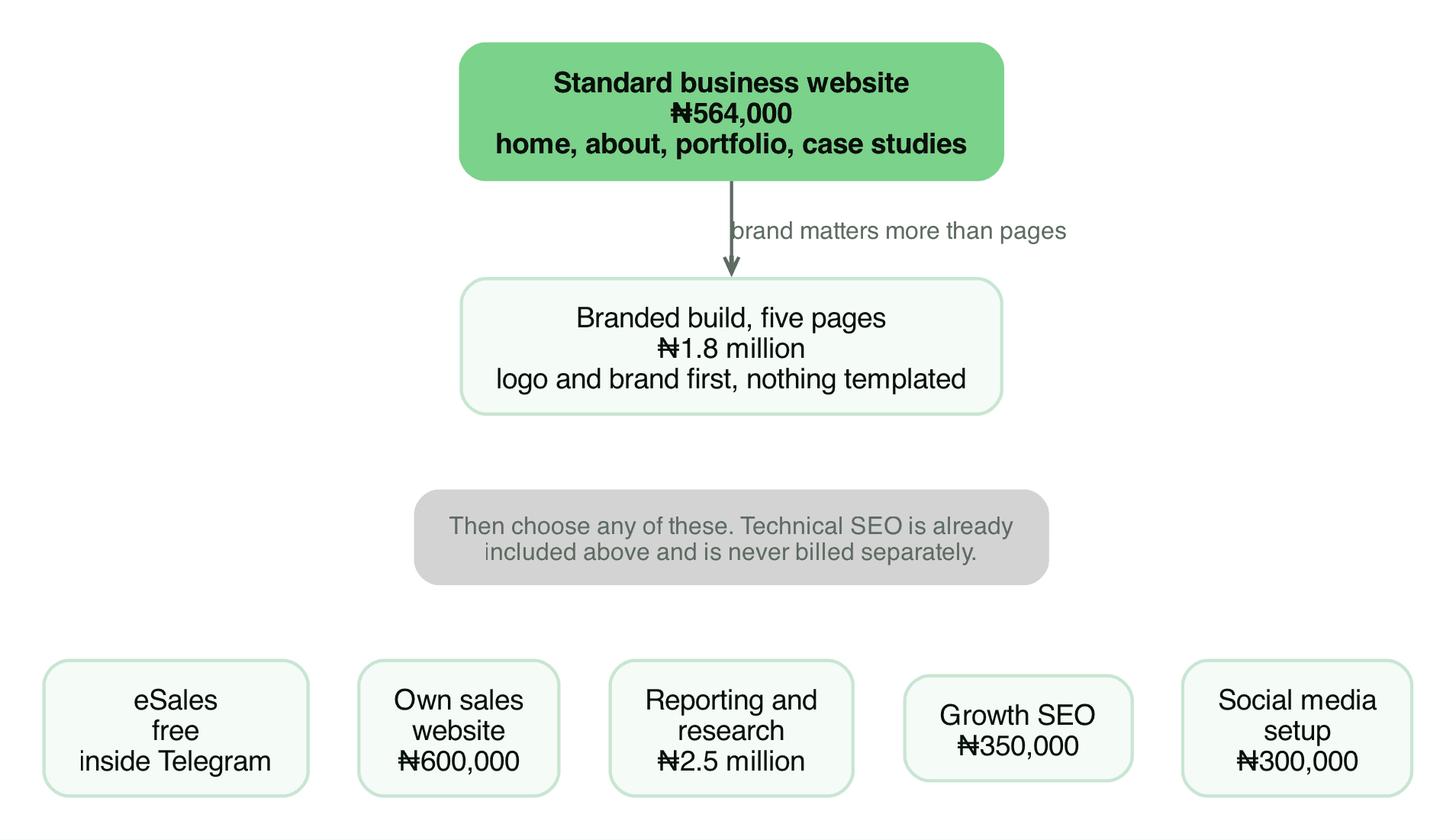
We price this ourselves, so here is our own answer rather than a summary of everyone else's. A standard business website starts at ₦564,000. That is the usual corporate website: we build on templates and a process we have used before, so we can get it live fast. You get a home page, an about page, a portfolio and case studies.
What pushes the price up is the brand. If you want a website and a logo and a look that is actually yours, that is a different job, and it starts at ₦1.8 million for five pages. Nothing is copied from a template. We spend time first understanding your business and what you are trying to say, because getting that wrong costs more than the build.
Selling on the website comes in three sizes, and the cheapest one is often the right one.
- You already sell on WhatsApp. Use eSales, which is free. It works inside Telegram, so your customers buy from a page inside the app without installing anything. It handles orders, tells you when one comes in, works out delivery charges by area, state and local government area, and takes stock off the shelf as each order is placed so you cannot sell what you do not have during a rush.
- You want your own website to sell on. That starts at ₦600,000, with a product list, product pages, checkout and an admin side for you to run it.
- You want to understand why sales go up and down. That starts at ₦2.5 million and includes proper reporting, testing how customers actually use the site, work on increasing revenue, and SEO in the same package.
Search work splits the same way. The technical part, which is making sure Google can actually find and read your pages, comes free with every plan above. That is not an extra line, it is part of building a site properly, and any agency charging you separately for it is charging you for something you already paid for. The growth work, which is ranking you for the terms your customers search, is separate and starts at ₦350,000.
Setting up your social media starts at ₦300,000, and it only comes as an addition to one of the plans rather than on its own. Most businesses open a Facebook page and start posting, then wonder why nothing comes of it. Every platform has its own audience and its own way of speaking, so we set up the pages properly and link them to each other, until your Facebook, your Instagram and your website all look like the same business talking.
Every plan comes with a month of full support around launch, then two more months after that for small fixes and for showing your team how everything works.
The same number, two different projects
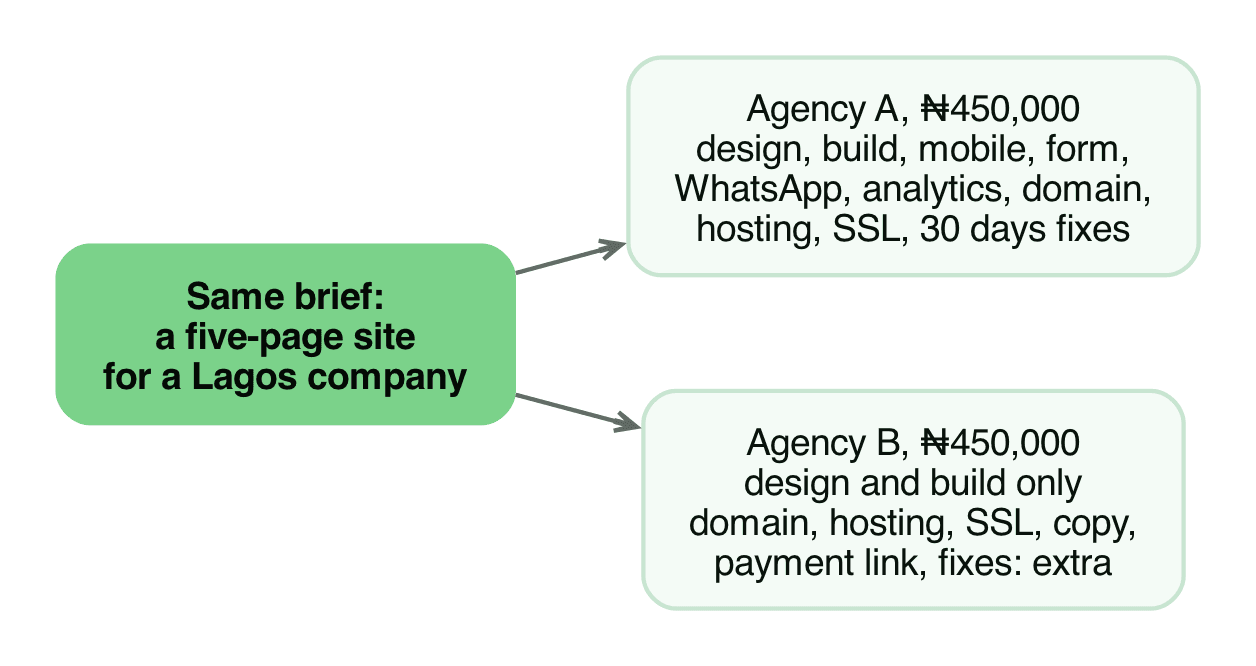
Test it with one brief. A five-page business website for a Lagos services company.
Agency A quotes ₦450,000. That includes design, build, mobile layout, a contact form, WhatsApp chat, Google Analytics, a domain, a year of shared hosting, SSL, Google Business Profile setup and thirty days of after-launch fixes.
Agency B quotes ₦450,000. That includes design and build only. Domain, hosting, SSL, the copy for the five pages, the payment link, analytics and any fix after handover are extras, quoted separately.
Same number. Agency A is building a website. Agency B is building pages and leaving you to assemble the rest. Settle that before you compare prices.
What a proper quote includes
Read every quote against this list. Anything missing is not free, it is unpriced.
- Domain name, usually .com.ng or .com, in your name and not the developer's.
- Hosting for year one. Shared hosting for a brochure site, a VPS or cloud plan for a store.
- SSL certificate. Free on most Nigerian hosts, and essential if you take payments.
- Design and build, with the page count written down, plus the mobile layout.
- Copy for each page, or a clear statement that you are writing it.
- Contact form with lead routing to email or WhatsApp, plus the click-to-chat button.
- Payment gateway integration, if you sell online.
- Analytics and Search Console setup, plus basic on-page SEO: titles, descriptions, headings, image alt text.
- Handover of the admin login and credentials, and a support window after launch, in writing.
What quotes usually exclude
These lines turn a ₦450,000 quote into a ₦700,000 project. None of them are dishonest on their own. Leaving all of them out is.
- Domain and hosting renewal from year two, which is also when introductory pricing often ends.
- Paid SSL, if the host does not include a free certificate.
- Stock photography, licensed fonts or premium plugins.
- Payment gateway transaction fees.
- Product upload and data entry for an online store.
- Email accounts on your domain.
- Content you were expected to supply and did not.
- Third party tools: email marketing, SMS, booking, chat, review software.
- SEO beyond the basics, and any ongoing content work.
- Changes after the agreed revision rounds, or a rebuild by someone else.
What the recurring costs really are
A website is not a one-off payment. Budget for year two on the day you sign.
Domain names, per year:
- .com.ng: about ₦3,000 to ₦10,000.
- .ng: about ₦9,200 to ₦17,500.
- .com: about ₦15,000 to ₦30,000, with renewal around ₦24,000.
Registrars run promotions, so check the renewal price, not just the entry price. WhoGoHost has advertised .com.ng at ₦3,000 and .com at ₦14,999 as limited-time pricing. QServers lists .com.ng at ₦5,500 and .com at ₦12,000, while HOSTAFRICA lists .com.ng at ₦6,999.
Hosting, per year:
- Shared hosting: roughly ₦22,000 to ₦100,000. QServers advertises it from ₦1,800 per month, HOSTAFRICA from ₦4,500.
- VPS or cloud: roughly ₦130,000 to ₦600,000. QServers advertises cloud VPS from ₦49,000 per month, HOSTAFRICA from about ₦11,000.
SSL, per year:
- Free DV certificate, usually Let's Encrypt and auto-renewed by the host: ₦0.
- Paid single-domain DV certificate: roughly ₦15,000 to ₦90,000.
- Wildcard, for multiple subdomains: roughly ₦45,000 to ₦180,000.
- Extended validation: ₦150,000 plus, and rarely necessary here.
Those figures come from HOSTAFRICA's SSL pricing guide. If your host bundles a free certificate, the honest SSL line on a quote is ₦0.
Payment integration:
- Paystack charges 1.5 percent plus ₦100 on local transactions, capped at ₦2,000, with the ₦100 waived under ₦2,500, and settles the next business day.
- Flutterwave charges 2 percent on local card transactions, capped at ₦2,000, after increasing from 1.4 percent in April 2025. It is the better choice only if you need its cross-border reach, since it also charges 4.8 percent on international transactions (BusinessDay's gateway comparison, September 2026).
- Getting a gateway set up costs nothing monthly, per HoganHost's payment guide, but not every provider is free to join. Interswitch's WebPAY carries a one-time ₦150,000 setup fee, so check the onboarding cost as well as the percentage. You pay per transaction once you are live.
So integration costs developer time, not a licence. Ask whether that time is inside the quote. On WooCommerce or Shopify a plugin makes it small; on a custom build it is engineering.
WhatsApp click-to-chat:
- The button is free. Click to chat is a link to your WhatsApp number, and Meta does not charge for it.
- The cost is the developer's time to add it, which is small, and separate from the WhatsApp Business Platform, the paid messaging product behind automated replies.
- If you already reply to customers from the WhatsApp Business app, this is all you need. Automated replies are a different project with a different bill.
A quote checklist for comparing two Nigerian agencies
Send the same brief to both and score the answers. The higher score wins, not the lower price.
- Is the domain registered in my name, and who renews it?
- Is hosting included in year one, and what is the renewal price?
- Is SSL included, and is it free or paid?
- How many pages, and how many rounds of changes?
- Who writes the copy, and is it in the price?
- What exactly gets built for a payment or checkout?
- What is not included that I will likely need in year one?
- What does a change after launch cost, and what is the support window?
- What are the delivery milestones, and what do you need from me at each one?
- Who owns the code and the accounts at the end?
- Can I see two live sites you built, and speak to one of those clients?
If a quote takes three days and comes back shorter than the brief, it is not a better price. It is a smaller scope.
A realistic week-by-week timeline
Most Nigerian small business websites run four to eight weeks. The build is not the long part. Waiting for content and feedback is.
- Week 1: discovery, scope, sitemap, quote signed and deposit paid.
- Week 1 to 2: copy, images and brand material collected. This is where projects stall. If you cannot supply content, pay for it or push the launch date now.
- Week 2 to 3: design of the homepage and one inner page for approval.
- Week 3 to 5: build of the remaining pages, mobile layout, forms, WhatsApp button and any payment integration.
- Week 5 to 6: your review, two rounds of changes, and content corrections.
- Week 6 to 7: testing on real phones, speed checks, analytics and SEO basics.
- Week 7 to 8: launch, DNS and email setup, handover of logins, support window starts.
Ecommerce adds two to four weeks, mostly for product upload, payment testing and a delivery workflow. A custom application is a different calendar, often two to six months. The TrustAm calculator gives landing pages one to two weeks and business sites three to six, which are the optimistic ends of the same range.
The ₦40,000 to ₦80,000 trap
You have seen the offers. A full business website for ₦50,000, delivered in three days, with a free domain.
Sometimes it works. If you need a single page and one phone number, a cheap template build can be the correct decision.
The trouble starts when the same offer is attached to something that has to handle customers, payments or logins. A developer who charged little to build a client's web app is the subject of a Nairaland post from December 2025 describing what the audit found: hard-coded credentials, no backend security, and a database design that failed under load. The site fell over when more than 50 people tried to log in, and the rewrite took two weeks.
That is the pattern. Here is what usually goes wrong.
- You own nothing. The domain and hosting sit in the developer's account, so leaving means starting again.
- There is no SSL, or it expires and nobody renews it, so browsers show Not secure.
- The design is a downloaded theme with your logo dropped in, on a phone screen that shows it.
- The contact form sends nothing, and the WhatsApp button points at an old number.
- Payment, if it exists, was never tested past one successful transaction.
- There is no admin, so every text change is a new invoice.
- The copy was never written, so the pages sit half empty.
- Nobody answers after launch, and the code is not in a state another developer wants to inherit.
The cheapest rebuild is the one that never happens. If you plan to spend ₦40,000 to ₦80,000, spend it on a landing page with one clear action, and accept that it is a landing page. Do not ask it to be a store.
A useful test before you pay a deposit: ask what happens to the domain, the hosting and the code if you stop working with them. If the answer is unclear, the price is not the problem.
When a cheap website is the right call
Not every business needs a ₦700,000 build, and saying otherwise would be dishonest.
- You are testing an idea and need something live this month.
- You need one page, one service and one phone number.
- You already have a Facebook or Instagram audience and the site is only there to look credible.
- You are willing to own the content and handle your own updates.
In those cases, a small template build with a domain, hosting and SSL in your own name is sound. Write down that it is a starter site, and plan to replace it later.
Do not buy an ecommerce build, a booking system or a customer login on the cheap. Those are the projects where the cheap version costs the most.
What to do next
Before you request a quote, write one page: what the site must do, how many pages, who writes the content, and your launch date. Ask every developer to answer the checklist above in writing. Then compare the answers, not the totals.
If you want a quote that spells out the inclusions and exclusions instead of hiding them, get a website built through our web development service. A standard build starts at ₦564,000. You will get a scope, a timeline and a named price, and you will know what is in it before you pay.
One final point. The market ranges here are drawn from Nigerian agency pricing and calculators published through 2026, and the naira moves. Re-check the sources before you commit to a budget, and treat any quote older than a quarter as a starting point for a new conversation.
Work with us
We design, build and automate the software Nigerian businesses grow on.
Stay in the loop
Get the latest updates and insights delivered to your inbox.
More like this
WhatsApp Cloud API Registration: Fixing 'Could Not Connect'
You cannot register a number for the WhatsApp Cloud API from the App Dashboard, only from the API. Here is the call that works, the permissions it needs, and the errors you will hit.
Read ArticleWhatsApp Cloud API: number connected, token ready, sends fail
The App Dashboard says your token is generated and the number is connected, then every send fails. Here is the system user fix, step by step.
Read Article