
Every few days since late August, a new Nigerian headline has landed: "WhatsApp to charge businesses per message," "Meta to charge ₦14 for WhatsApp Business messages," "WhatsApp's ₦14 fee could cost MSMEs ₦14m per million messages."
The tone is alarming, and the numbers in the headlines are technically correct. What almost none of the coverage does is answer the two questions a Nigerian business owner actually has:
- Do I pay, or is this not about me?
- If I do pay, how much, and what do I do about it?
Both answers are more reassuring than the headlines suggest, and also more demanding. But there is a third answer the headlines completely miss, and it is the one that matters most: the fix is not to send fewer messages. It is to change what a "message" has to be.
TL;DR
- What changes on October 1, 2026?: Meta starts charging per message for service messages, and for utility messages sent in reply inside the 24-hour customer service window. Both were free before.
- Who is affected?: Businesses on the WhatsApp Business Platform, the API, not the free WhatsApp Business app on your phone.
- How much?: Roughly ₦10 per message, and Meta's indicative rate is about $0.0101. Marketing messages are far higher, around $0.06, or ₦80+. Final rates come with Meta's October rate card.
- The relief: Every business phone number gets 1,000 free service messages per month, counted per message, resetting monthly, no rollover.
- The urgent bit: If you're on the API with no payment method on file by September 30, 2026, Meta will stop delivering your service messages from October 1.
- The real answer: Reframe the conversation. At CIP Topup, a whole app runs on two WhatsApp Flows, authentication and product sale, which took task completion from six messages down to one, at most two.
Direct answers: the short version
Does WhatsApp charge Nigerian businesses now? Only businesses on the WhatsApp Business Platform, the API. From October 1, 2026, service messages and in-window utility messages are billed per message at roughly ₦10 each. The free WhatsApp Business app is unaffected.
Is there a free allowance? Yes: 1,000 free service messages per business phone number per month, counted per message, resetting monthly with no rollover.
What is the cheapest way to reduce the bill? Convert high-volume conversations into WhatsApp Flows so a task completes in one message instead of many. Then separate utility from marketing templates, and use the 24-hour and 72-hour free windows deliberately.
What is actually changing
Let's be precise, because most of the reporting blurs it.
WhatsApp business messaging has four message categories: marketing, utility, authentication and service. Meta has been moving it to per-message pricing since July 2025. Two things were still free, and both go away:
- Service messages: the free-form replies your team or bot sends after a customer messages you, inside the 24-hour customer service window. Free since November 1, 2024.
- Utility messages sent in response to a user inside that same open window: order confirmations, payment notifications, delivery updates. Free since July 1, 2025.
Meta's developer documentation is explicit. Effective October 1, 2026:
"Meta will charge on a per-message basis for all service messages, consistent with how Meta charges for template messages."
and
"Meta will charge on a per-message basis for utility messages sent in response to users, within an open 24-hour customer service window."
Service messages will be billed at the same per-message rate as utility and authentication templates in each country. Meta confirmed the country rates on September 1, 2026. The 24-hour window still exists, but replying inside it now has a meter attached.
Who actually pays, and who does not
This is where most of the panic gets silly.
If you use the WhatsApp Business app on your phone, the free one, you are not the target. The change applies to the WhatsApp Business Platform, the API used by businesses running high volumes through chatbots, CRMs and third-party tools. A tailor in Yaba replying to customers herself should not panic.
If you use the API, you are affected. That includes banks, fintechs, retailers, airlines, telcos, e-commerce platforms and any business that has wired WhatsApp into software to handle conversations at scale.
And the relief is real: 1,000 free service messages per business phone number per month. It is counted per message, not per conversation, it resets every month, and unused messages do not roll over. Three business numbers get 3,000 free messages between them, but only as 1,000 each.
For a business doing modest inbound support, that free tier can mean Meta charges you nothing. Confirm your setup before you budget for a bill you may not owe.
Why ₦10 a message breaks low-margin businesses
Here is the part the headlines miss, and the part that matters most to Nigerian SMEs.
₦10 per message sounds small in isolation. It is not small in the context of how Nigerians actually buy.
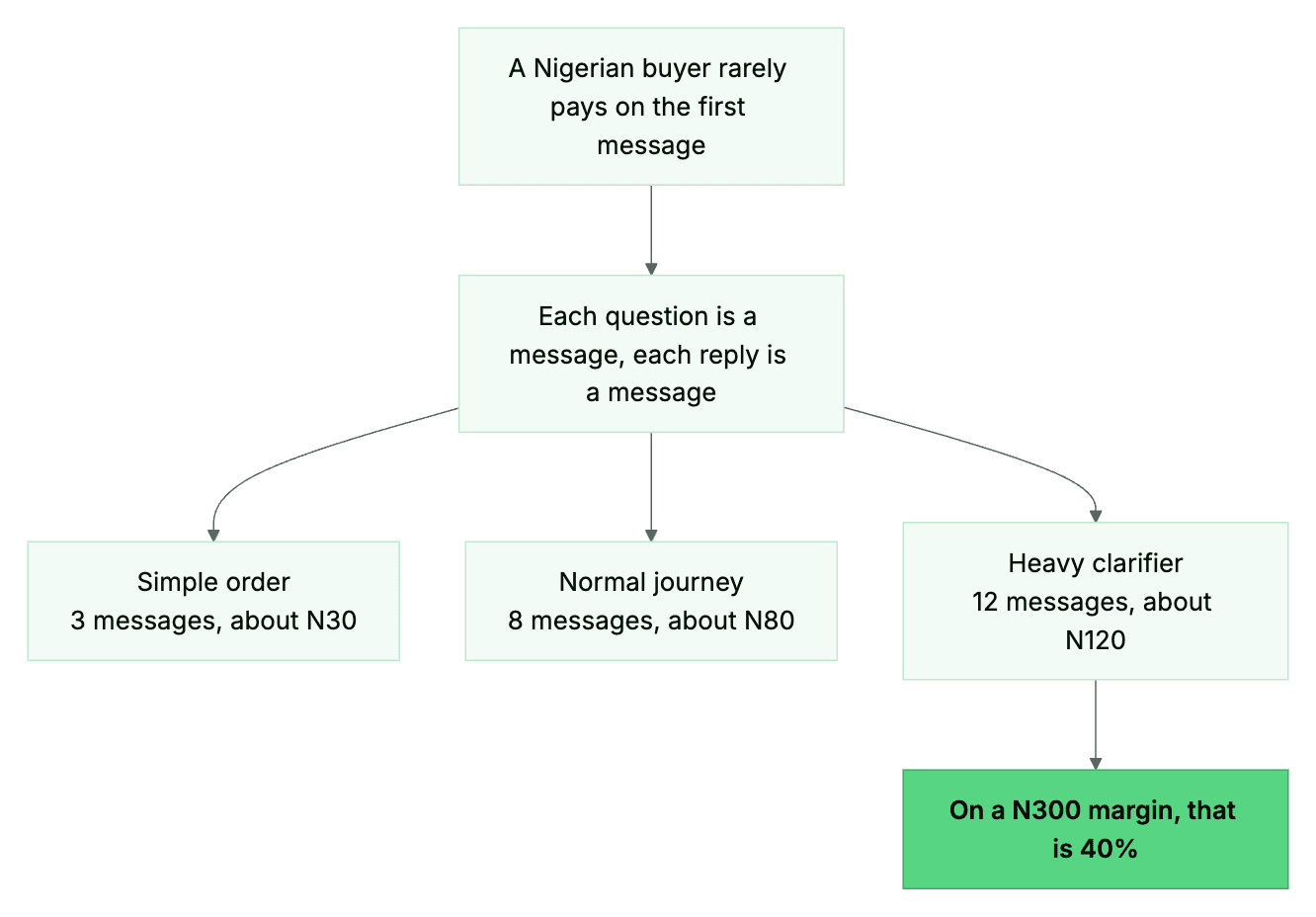
A Nigerian buyer rarely sends one message and pays. They ask a sequence of clarifying questions before committing:
- "Is it available?"
- "How much is the last price?"
- "Is it original?"
- "Can you deliver to [area] today?"
- "Do you accept transfer or pay on delivery?"
- "Send me the account details."
Each of those is a message. Each reply from your business is a message. And after October 1, each one inside the window is billable.
That behaviour is exactly what per-message pricing punishes. For a business with fat margins, ₦10 is noise. For a business with thin margins, thrift and fashion resellers, food vendors, small electronics, anything competitive on price, it is a direct tax on the way customers prefer to shop.
Put numbers on it:
- Simple order, decisive buyer: 3: ₦30: ₦2,000: 1.5%
- Normal Nigerian buying journey: 8: ₦80: ₦800: 10%
- Heavy clarifier, thin margin: 12: ₦120: ₦300: 40%
That last row is the danger. A large share of Nigerian online sellers live there. When nearly half the margin can go to messaging, "send fewer messages" is not a strategy. It is an admission that you cannot run the business the way your customers want to buy.
And there is one more trap: if a business mixes a promotion into a transactional reply, the message can be classified as marketing and billed at roughly six times the rate. Keep utility and marketing strictly separate.
What Nigerian businesses are actually saying
If you want to know how this is landing, TikTok is the fastest place to hear real Nigerian operators react.
Most Nigerian coverage quotes ₦14 per message, using an exchange rate of about ₦1,337 to the dollar; at a stronger rate the same fee comes closer to ₦10. Either way, the reaction is the same. A radio presenter's breakdown walks through exactly why SMEs are worried, 10,000 replies a day, multiplied by the per-message fee, and others are blunter: "14 naira per text on WhatsApp business messages, this is uncalled for."
The most useful takes are the ones that get the nuance right. One explainer sums it up as "customer starts it, you're covered; you start it, you're the one paying", because a customer-initiated conversation through a click-to-chat still stays free for 72 hours. And the 1,000 free service messages per business number is confirmed by others.
So why do Nigerian buyers send so many messages before paying? Because trust has to be earned. As one Nigerian marketer puts it: "If you're selling something to Nigerians, show proof... when Nigerians see real proof, then they will trust you." Every one of those proof-seeking messages is now a billable one. The behaviour is not going away. The message count has to.
The fix we used at CIP Topup: WhatsApp Flows
This is the part we can speak to directly, because we hit this problem building a WhatsApp bot long before the pricing change forced the issue.
The instinct is to make the bot send fewer messages. Wrong target. The right target is *message turns***.
What we do at CIP Topup is use WhatsApp Flows. A Flow is a multi-screen, interactive form that renders natively inside WhatsApp. The customer taps a button, a clean interface slides up, and they pick options, enter details and confirm, all inside the chat, without leaving the app and without a website loading.
The difference in cost is structural, not incremental:
- Old pattern: bot asks name → customer answers → bot asks for amount → customer answers → bot confirms → customer confirms. Six messages, each a chargeable turn, with the customer waiting between each one.
- Flow pattern: one message carries the entire interaction. The customer makes every choice on one screen, taps once, and the outcome is done.
At CIP Topup, the entire app is built on just two Flows, one for authentication and one for product sale, and the user takes action with a single message.
The before-and-after is the whole argument. The old bot-style flow took about six messages to complete a task: bot asks, customer answers, bot asks again, and so on. With Flows, the same task takes one message, at most two. Same app. Same tasks. A fraction of the message turns, and therefore a fraction of the bill once service messages are charged.
The benefits compound:
- Cost. One message instead of many, which is the entire game under per-message pricing.
- Speed. No waiting between turns. The customer finishes in one interaction.
- Completion. Flows render natively and are lightweight, so they behave well on budget Android phones and patchy connections where a website handoff would fail.
- Data quality. Flows collect structured input, not free text, so downstream processing is cleaner.
- Predictability. You know the maximum number of chargeable messages a task will take, because the task is one message.
Flows are not a workaround. They are Meta's own recommended way to "collect as much data as possible at once" and replace clunky back-and-forth. The businesses that adopt this pattern will barely notice October 1. The ones that keep chatting free-form will feel every naira.

The measured result at CIP Topup: a task that used to take six messages now takes one, and never more than two. Under per-message pricing, that is not a small optimisation. It is the difference between a bill that scales with every customer question and one that barely moves as you grow.
The deadline nobody is talking about
The most urgent item is not the price. It is this, from Meta:
"For any Solution Provider or directly-integrated businesses that does not have a payment method on file by September 30, 2026, Meta will stop delivering service messages as of when they become charged on October 1, 2026."
It does not say you will be billed more. It says your messages may simply stop.
For a business whose support, order updates or payment confirmations run over WhatsApp, that is not a cost problem. It is an outage. If you depend on the Platform, confirm with your BSP in the next two weeks that a valid payment method is on file and billing is set up.
Everything else can wait for the rate card. This cannot.
Why Meta is doing this, and what it signals
Meta built WhatsApp into business infrastructure: three billion-plus monthly users, and in Nigeria the most-used platform in the country, used by roughly 96.5% of internet users according to Statista's Q3 2025 data. More than 200 million businesses use WhatsApp Business monthly worldwide.
Infrastructure, once everyone depends on it, gets monetised. Meta has been moving WhatsApp to per-message billing since July 2025, and charging for service replies is the logical next step.
It is the same pattern in every Nigerian digital channel: a platform is free and generous while it builds dependency, then it charges for the behaviour it trained. The businesses that get hurt are the ones that treated the free channel as permanent and never changed how they operate.
The real story is not ₦10. It is that your customer conversations now have a running cost attached, and the only durable defence is better interaction design, not fewer customers.

What to actually do
A practical plan, in priority order.
1. Confirm your setup. Business app or Business Platform? Most panic dissolves here.
2. Secure billing by September 30. If you are on the Platform, confirm a payment method is on file so your messages do not stop.
3. Convert high-volume conversations into Flows. This is the big one. Identify the ten tasks customers ask for most, and collapse each into a single Flow. One message, one action, done.
4. Audit every template. Strip promotional language out of utility templates. Keep marketing and utility strictly separate. A misclassified message costs about six times more.
5. Use the free tiers deliberately. Customers message you first to open the 24-hour window; click-to-WhatsApp ads and Facebook Page buttons give a 72-hour free entry window. Design acquisition so more of your volume sits inside free windows.
6. Budget against the 1,000 free messages per number. Small businesses may owe nothing. Larger ones should plan from message 1,001.
7. Cut the waste. "Hello, how are you?" messages, redundant confirmations and steps that do not move the customer forward now carry a price. Rewrite journeys to resolve in fewer turns.
8. Build owned channels. Email, an app, a website and your own customer database do not have a Meta meter attached. Diversify so you are not hostage to the next pricing change.
9. Route low-value chatter off WhatsApp. Direct simple inquiries to webchat, Instagram or email, and keep WhatsApp for conversations moving toward a sale or a critical resolution.
FAQ
Will I be charged for using WhatsApp Business in Nigeria? Only if you use the WhatsApp Business Platform, the API. The free WhatsApp Business app is not the target of these charges.
How much per message? Roughly ₦10 for service/utility messages to Nigerian numbers, and around ₦80+ for marketing. Final figures come from Meta's October rate card.
Is there a free allowance? Yes. Each business phone number gets 1,000 free service messages per month, counted per message, reset monthly, no rollover.
What happens if I don't add a payment method? If you're on the Platform and have no payment method on file by September 30, 2026, Meta says it will stop delivering your service messages from October 1.
How do I reduce the bill? Convert conversations into WhatsApp Flows so a task takes one message instead of many. Separate utility from marketing templates, use the free windows, and cut unnecessary messages.
Do Flows cost extra? No. A Flow is delivered as a message, so it is priced like the message that carries it, but it replaces an entire series of message turns, which is where the saving comes from.
Related reading
- VTU app architecture: credits, retries and reconciliation.
- How to choose a VTU API provider.
- How we built CIP TopUp.
The businesses that won't feel October 1
They will be the ones that stopped treating WhatsApp like a chat and started treating it like a product, where a customer completes a task in one structured message instead of a dozen turns. We have already built it, at scale, on our own platform.
We design the Flows, automation and products behind customer conversations. Build with us.
Stay in the loop
Get the latest updates and insights delivered to your inbox.
More like this
How to Start a VTU Business in Nigeria: A Practical 2026 Guide
A grounded guide to starting a VTU business in Nigeria in 2026: the models, what it actually takes, how the money works, and the three things that quietly kill VTU businesses.
Read ArticleAI Video in Nigeria Is Either Brilliant or a Joke. There Is No Market for the Middle.
AI video is bimodal: it either earns praise or gets laughed at, and the middle sells nothing. Here is what Nigerian businesses should do, why familiar faces beat better models, and why the real moat is infrastructure, not the prompt.
Read Article