

Ask a Nigerian business owner about AI video in 2026 and you get one of two reactions. Either "AI can make my adverts now, so I don't need to spend on a shoot" or "AI video is fake, my customers will never trust it."
Both are wrong, and both come from the same mistake: treating AI video as a production story. It is not. It is a distribution, trust and infrastructure story, and the businesses that understand that are the ones who will win with it.
We build software and automation for Nigerian businesses, so we watch this from the operations side rather than the camera side. Here is what is actually happening, what the tools can and cannot do, and what we would do with them if we were spending a marketing budget in Nigeria this quarter.
TL;DR: what actually matters
- The best AI video model wins: Model choice is not the advantage. The hook, the format, and iteration cost decide the outcome.
- AI video replaces shoots: It replaces some production. It does not replace trust, human identity, or strategy.
- It is basically free: Generation is cheap per clip. In Naira, the all-in cost of getting to a usable clip is still high.
- Make it good: AI video is bimodal. It gets praised or it gets laughed at. The middle gets ignored.
- Original AI faces are the future: Familiar faces win. Face swap and character swap outperform generic AI faces.
- AI video is a Nigerian opportunity: It is an opportunity and a risk. AI video fraud is already hurting real Nigerian brands.
Direct answers: the short version
Does AI video work for Nigerian businesses? Only at the extremes. It either earns praise for being impressive or gets shared for being funny. The "obviously AI but not memorable" middle gets scrolled past and sells nothing.
Why do face swaps beat original AI faces? Because Nigerian audiences buy from faces they already know. Familiarity carries trust and story; a generic AI person carries neither.
So what's the actual advantage? Not the model: the infrastructure that lowers the cost per usable clip. In Naira terms, AI video is still expensive because of iterations, and whoever builds the cheapest path from idea to tested variants wins.
The landscape, honestly
The tools are genuinely good now, and that part is not hype. But they are good at different things, and the marketing around them hides that.
- Google Veo 3.1 produces the most cinematic, photoreal footage, and it is the one that generates synchronized audio, dialogue, ambient sound and effects, in the same pass. It is the default for "prompt in, finished-feeling clip out."
- OpenAI Sora 2 is the narrative engine. It is strong at prompt adherence and multi-shot storyboarding, and it supports longer clips, which matters when you need a sequence rather than a moment.
- Runway Gen-4.5 is the control room. Keyframes, camera direction, motion brush, video-to-video editing. If you want to direct a shot rather than reroll it, this is the one.
- Kling 3.0 from Kuaishou is the value-and-motion play. Longer clips, strong full-body movement, and pricing that makes high-volume work affordable.
- Seedance 2.5, inside ByteDance's TikTok Symphony, is the platform-native option, and TikTok has been pushing AI-generated ad length out to around 30 seconds.
They separate on philosophy, not raw quality. Veo optimises for "point, prompt, get a beautiful clip with sound." Runway optimises for "I need to steer this shot." Sora optimises for "tell me a story across scenes." Kling optimises for "give me more seconds, cheaper."
Pick the philosophy before you pick the product. Most Nigerian businesses do the opposite, subscribe to whatever is trending, and then blame the tool when the ad does not sell.
What Nigerians are actually searching for
This is not a niche curiosity in Nigeria. Look at the search behaviour over the last year:
- "google flow ai video": up roughly 187,000%
- "qwen ai video generator": up roughly 157,000%
- "faceless reels.com": up roughly 148,000%
- "nano banana image generator": up roughly 138,000%
- "veo 3": up roughly 98,000%
- "sora 2": up roughly 53,000%
Those are Google Trends signals for Nigeria. A wave of business owners, creators and hustlers are actively looking for ways to generate video with AI right now. Demand for the how is enormous. Reliable, Nigeria-specific guidance on the why, and on what actually works, is almost nonexistent.
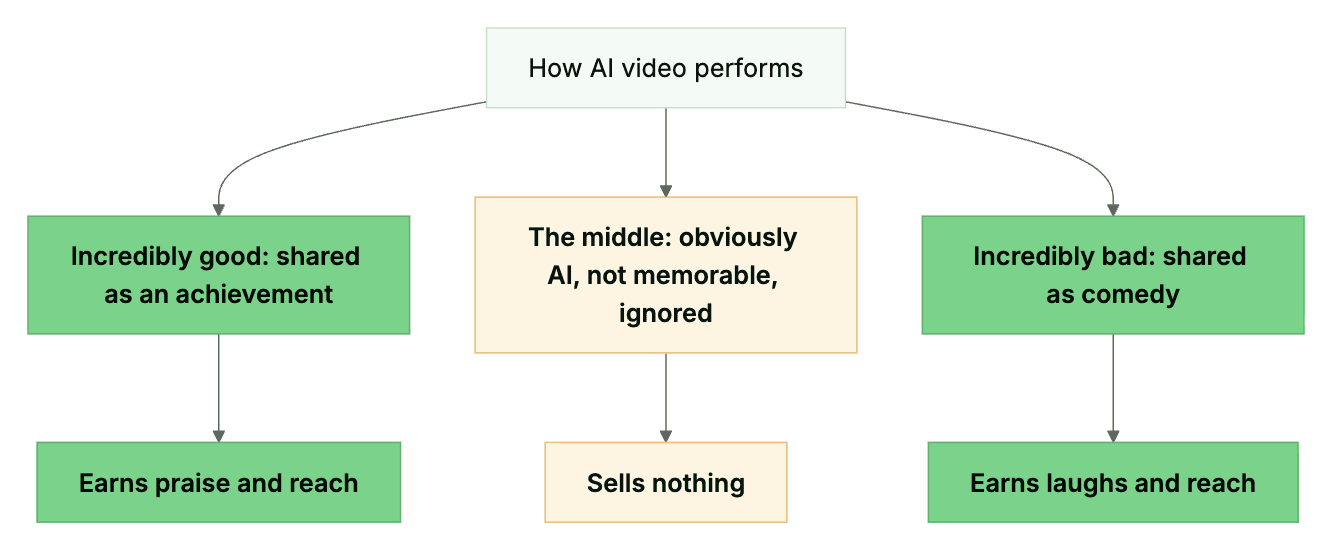
Rule one: AI video is bimodal. Be brilliant or be hilarious.
This is the observation that changes how you should plan, and almost nobody says it out loud.
AI video does not perform on a curve. It performs in two extremes.
- Incredibly good gets shared as an achievement. People applaud it, tag friends, and ask how it was made. It earns the brand kudos and reach.
- Incredibly bad gets shared as comedy. The uncanny hands, the melting face, the nonsense voice. Audiences pass it around to laugh at it, and the algorithm rewards the engagement anyway.
- The middle gets nothing. A clip that is obviously AI but not impressive and not funny enough to mock is simply scrolled past. There is no market for "decent."
That is counterintuitive for anyone trained on traditional production, where the goal is a competent, professional ad. In AI video, competent is the one place you do not want to be. The distribution system rewards extremes, and the audience decides which extreme you are in within the first two seconds.
The practical implication is blunt: do not ship "okay" AI video. Either invest enough to land in the top tier, good enough to earn genuine praise, or deliberately commit to the joke and let the badness be the point. What you must never do is release something in the forgettable middle and hope volume makes up for it.
This is not a theory. Search "AI video fail" on TikTok and you will find an entire genre with enormous engagement. Clips like the Sora "granny hand dryer" fail circulate as comedy, and dedicated AI-fail accounts have built large audiences on AI going wrong. The laugh is real distribution. So is the praise: the same platform rewards genuinely impressive AI storytelling. What gets nothing is the clip in between: competent, obviously AI, and forgettable.
And be honest about which extreme you can actually reach with your current setup. If you cannot consistently produce top-tier output, the smarter play for many brands is not to fake prestige. It is to own the humour, or to use AI where it is invisible, like B-roll and versioning, rather than centre-stage.
Rule two: familiar faces beat better models
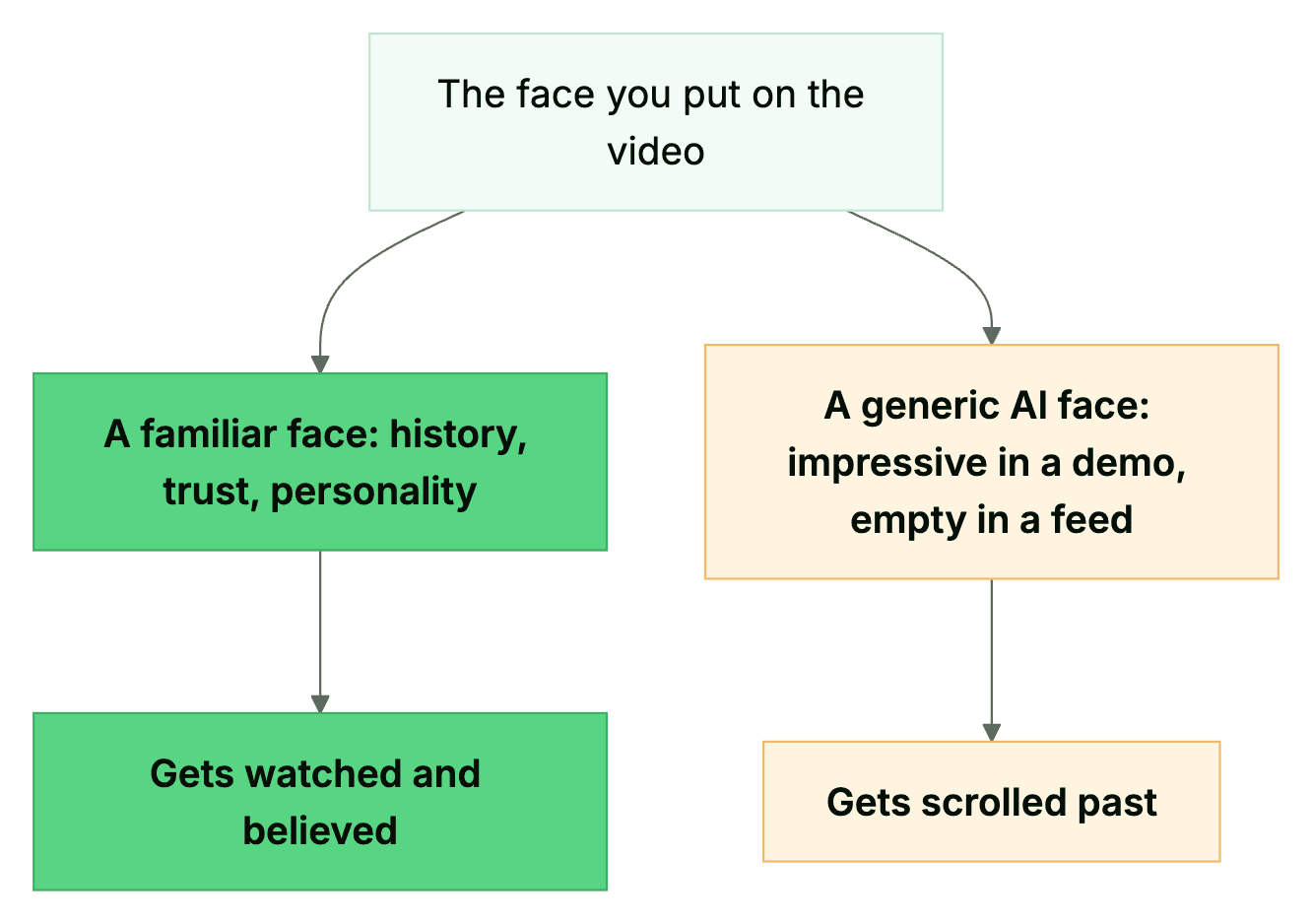
Here is the other thing the tool comparisons never tell you: Nigerian audiences do not want AI video with an original AI-generated face. They want AI video attached to a face they already know.
That is the entire reason face swap and character swap are blowing up rather than pristine, fully synthetic humans. Tools like Higgsfield have built a viral product on exactly this: one-click face swap and "Recast" character swap that put a known person into any scene, and they are used by a reported 15 million creators. Generic AI people look impressive in a demo and feel empty in a feed. A familiar face carries history, trust and personality for free.
You can see it in the creators winning on Nigerian TikTok right now, all of whom use AI to extend an identity the audience already knows, not to invent a stranger:
- Classy Jester, @classy_jesters, is a Nigerian comedian who moved from skits into AI content and now brands himself "Biggest AI Creator in Africa." Around 1.1 million TikTok followers and 18.3 million likes, with tutorials like "Create AI Videos Easily Without Experience" teaching the format. The face is the asset; AI is the amplifier.
- HAMZZY, @hamzzythecreator, is a Nigerian creator with roughly 2.7 million followers and 60.2 million likes, producing AI-driven comic and movie content, with pinned posts pulling tens of millions of views.
- JARVIS AI, @realjadrolita, is the Nigerian creator who built a "Human AI" robot persona, now at roughly 11.1 million followers and over 443 million likes. She is the clearest proof of the point: the audience is not attached to the AI, but to her, performing through it.
That last example reframes how to think about the whole category. The AI is not the product. The familiar human is the product, and AI is the delivery mechanism.
For brands, the lesson is direct:
- Put your own face or a known face on the AI, not an anonymous synthetic one.
- Use face swap and character swap to place a familiar person into scenes you could never afford to shoot.
- Do not lead with "look, it is AI." Lead with a person the audience recognises and a hook that earns attention.
Rule three: the Naira cost, and why infrastructure wins
The clean story is "generation costs cents instead of millions of naira." That is true, and it is also not the whole truth, because in Nigeria, AI video is still expensive.
The cost is not the model. It is the iterations. You generate twenty clips to keep one. You prompt, reject, reprompt, wait, and repeat. Each cycle burns credits, time, data and attention, and those all cost money in Naira, at a scale a small Nigerian business feels immediately.
What it actually costs in Naira: a real example
This is not theoretical. A Nigerian AI creator, Coach Blessing, recently broke down what Google's Flow from Google Labs costs a Nigerian user, and the numbers are the whole argument. Watch the breakdown here: watch the video.
- 200 credits: ₦1,950: ~₦9.75
- 1,000 credits: ₦7,100: ~₦7.10
And every generation burns credits depending on which model tier you pick:
- Light: 10: ~₦71
- Flash: 15: ~₦107
- Fast: 20: ~₦142
- Quality: 100: ~₦710
Look at the spread. The cheapest tier costs about ₦71 per generation; the top tier costs about ₦710, ten times more for the same prompt. And nobody ships the first take. Run five iterations on the quality tier and you have spent roughly ₦3,550 to get one clip you might keep. Run the same five on the light tier and it is about ₦355.
That single comparison is the entire infrastructure thesis. Coach Blessing's own advice is exactly the model-routing principle: stick to the cheaper tiers, light, flash and fast, to stretch your credits. Iterate cheap, finalise expensive. The businesses that build that discipline into a pipeline will produce many times the tested creative for the same naira as the ones paying premium rates for every throwaway draft.
Cost per minute across the major models
Zoom out and the same story repeats: the price depends far more on the model and its settings than on the idea. A Nigerian creator who compared the major video models, converting credits and API pricing into real money, found the spread runs from well under a dollar per minute on Flash-class models up to roughly $24 per minute on Veo 3.1 Quality. See the full breakdown. Kling 3.0 sits around $10 to $25 per minute depending on resolution and whether you add audio, and Seedance 2.0 varies even more.
Read that range again. The gap between a rough draft and a premium final is not 20%. It is often closer to 20x. Which is exactly why "which model is best" is the wrong question, and "what does a usable clip cost across my whole workflow" is the only one that matters.
So the real competitive advantage in Nigeria will not come from having the best model. It will come from whoever can build the infrastructure that reduces iterations and lowers the cost per usable clip. That is an engineering problem, not a creative one, and it is exactly the kind of problem we solve.
What that infrastructure looks like:
- A tested prompt library. Reusable, versioned prompt templates for the shot types you actually use, so nobody starts from a blank page.
- Model routing. Use cheap, fast models for drafts and exploration, and route only the finalists to the expensive, high-fidelity model. Most iterations should never touch the premium tier.
- Batch generation and caching. Generate multiple variants in one pass and reuse winning elements instead of regenerating everything from scratch.
- Automated QC. Screen outputs for the obvious failures, mangled hands, drifting faces and bad text, before a human looks, so human review time goes to the clips that matter.
- A reusable asset library. Product shots, brand elements, voice profiles, aspect-ratio templates. The more you reuse, the fewer generations you pay for.
- Measurement. Track cost per usable clip, not cost per generation, and drive it down every month.
The three-layer bill of generation, orchestration and review only gets cheaper if you attack the middle and the waste. That is why the businesses that will boom in Nigeria are the ones that treat AI video as a pipeline, not a subscription.
The stack we actually use
This is not hypothetical for us. Our own AI video workflow is Replicate for generation by API, Seedance as the model, and CapCut for the edit.
Why that combination matters under per-second pricing:
- Replicate bills by output, not by a subscription bucket. Its official models are priced by the seconds of video you produce, so you pay for what you keep. No monthly pack of credits you feel pressured to burn before they expire.
- Seedance comes in tiers, Mini, Fast, standard and 2.5, and Mini costs roughly half of the standard tier. You prototype on the cheap tier at low resolution, then re-render only the winner. That is model routing, applied.
- CapCut handles the last mile: assembly, captions, voiceover and aspect-ratio versions, the orchestration layer that turns raw clips into publishable ads, often at no extra cost.
Seedance on Replicate is billed per second of output, and the rate moves with the model and resolution, from a few cents per second on the Mini tier up to around $0.34 per second at 1080p on the standard tier. In Naira, that is the difference between a draft that costs tens of naira and a final that costs a few thousand.
The point is not that this is the only stack. It is the shape of the answer: an API aggregator for flexibility, a tiered model for cost control, and a free editor for the last mile. Iterate cheap. Finalise expensive. Never pay premium rates for a throwaway draft.

The Nigeria-specific reality
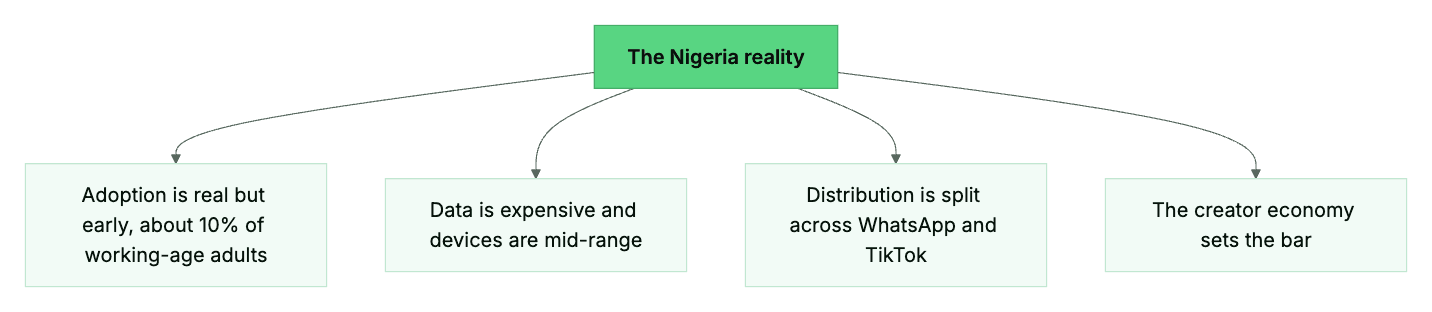
Global AI video advice assumes fast internet, cheap data, cards that work on foreign subscriptions, and audiences who have seen a thousand AI clips. Nigeria is none of those by default.
Adoption is real but early. Microsoft's Global AI Diffusion report for Q1 2026 puts generative AI use among Nigeria's working-age population at 10.1%, behind South Africa's 23.1% and well behind the global average. The people searching for AI video are ahead of the market, an advantage for early movers, and a warning against assuming customers understand what they are looking at.
Infrastructure shapes the output. Data is expensive and devices skew mid-range, so heavy, high-bitrate video is a poor default. Short, captioned, compressed, vertical clips travel better. AI makes producing those cheap; it does not change who can watch them.
Distribution is not one channel. WhatsApp is the most-used platform in Nigeria. Statista's Q3 2025 data puts it at roughly 96.5% of internet users, and TikTok reaches tens of millions more. A single hero video is not a distribution strategy. A pipeline that produces many formats and routes them per channel is.
The creator economy sets the bar. At the 2026 AAAN congress in Lagos, agency leaders framed the moment as "the end of advertising as we know it," with AI lowering the barrier to producing copy and visuals. Their conclusion was not that AI wins, but that human creativity, cultural understanding and judgement become the differentiator once everyone can generate. Which is exactly why familiar faces and human identity matter more, not less, as AI floods the feed.
Tooling is getting more accessible. Partnerships like Canva Africa and Paystack's bundle for Nigerian merchants are pushing AI creative tools into the hands of small businesses. The barrier is falling. When everyone has the same tools, the edge is workflow, not access.
The trust problem is not a footnote
This is the part the global AI video conversation almost never covers for Nigeria, and it matters more than model quality.
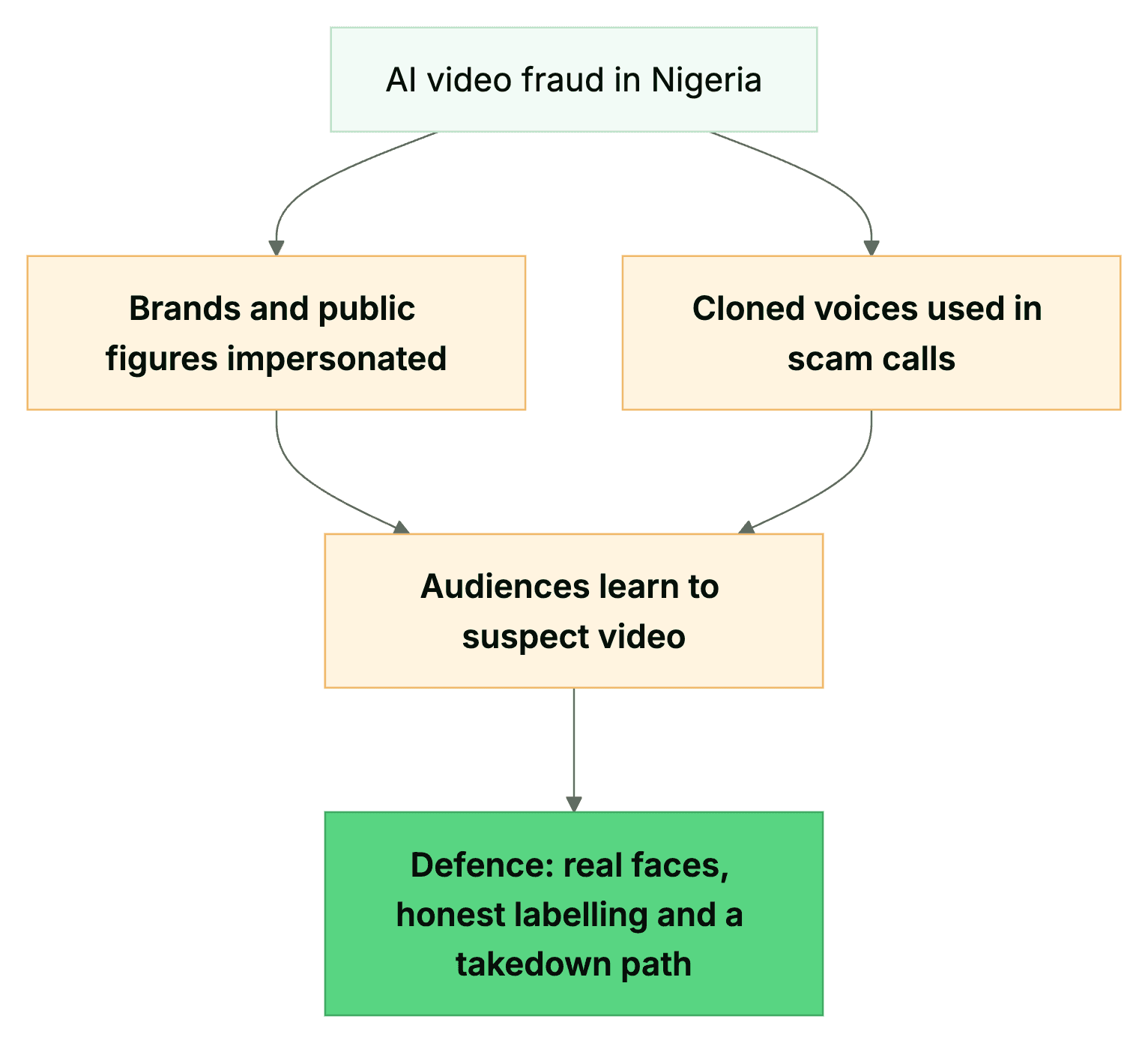
AI video is already being used against Nigerian consumers at scale. A Premium Times investigation documented AI-generated adverts impersonating trusted brands and public figures: deepfake videos and cloned voices using the likenesses of figures like Aliko Dangote and the Emir of Kano, running as paid promotions on TikTok, reaching an audience of over 37 million Nigerian users. One scheme impersonated a major fintech with a convincing synthetic voice promising free POS machines and cash grants.
Nigeria also recorded a reported fourfold jump in AI-video fraud in 2024, and analysts expect deepfake misuse to keep rising as the tools get cheaper.
TikTok shows how personal this has become. One creator's warning video, from @protec_ai, is a scenario every Nigerian family will recognise: a cloned voice of a relative calls, and the victim sends ₦50,000 before realising. Another, @nazovin, documented a fake AI-generated advert featuring his own likeness. When anyone's face and voice can be generated, being verifiably real stops being a nicety and becomes the whole point.
Two hard consequences follow for any business planning to use AI video:
- Your audience is now trained to suspect video. A suspicious audience punishes anything that looks synthetic, especially in financial services, health, and any category where scams operate. This is another reason generic AI faces fail and familiar ones win. Familiarity signals safety.
- Your brand can be impersonated cheaply. If a fraudster can generate a convincing clip of your CEO in an afternoon, trust is a moving target.
Which is why "AI video is fake, my customers won't trust it" is a reasonable instinct. The mistake is concluding the answer is to avoid AI video. The answer is to use it without leaning on deception: real faces, honest labelling, and a fast takedown path when someone impersonates you.
What actually works: the playbook
If we were running this for a Nigerian brand tomorrow, this is the operating model.
1. Decide which extreme you are aiming for. Top-tier praise, or deliberate humour. Never ship the forgettable middle.
2. Build around a familiar face. Your founder, a known creator, or a recognisable character, using face swap and character swap where it helps. AI amplifies identity; it does not create trust from nothing.
3. Start with the hook, not the tool. Write ten hooks and rank them before generating a clip. AI will happily make a gorgeous video for a boring hook.
4. Use AI where it is invisible or additive. B-roll, locations, motion graphics, multilingual voiceover, and fast versioning of a winning concept, not as a replacement for trust.
5. Engineer the pipeline, not the clip. Prompt libraries, model routing, batch generation, automated QC, reusable assets. Drive down cost per usable clip every month.
6. Build a testing loop. Ship variations fast, read the data, and feed winning elements back as references for the next batch. Creative is a pipeline with a weekly cadence, not a quarterly campaign.
7. Label AI where it matters and protect the brand from impersonation with monitoring and a takedown path.
8. Measure outcomes, not aesthetics. Qualified conversations, leads and sales per naira spent, not "did it look good."
Our read: where this actually goes
AI video will become table stakes within a year or two. Every agency and serious brand will have it, the way everyone has a website today. At that point the technology stops being the story.
What remains scarce is:
- Judgement. Knowing which of thirty drafts is worth shipping, and which extreme you are in.
- Familiarity. A known face and a real identity in a feed full of synthetic noise.
- Infrastructure. The pipeline that makes iterations cheap enough to test properly. In Nigeria's cost environment, this is the moat.
- Distribution you own. Channels you control, not just attention you rent on platforms that change the rules overnight, which is exactly why the WhatsApp pricing change this October matters so much.
The Nigerian businesses that win with AI video will not be the ones with the best model subscription. They will be the ones who built the cheapest path from idea to thirty tested variants, put a familiar face on it, and turned output into conversations.
That is a software and operations problem as much as a creative one. Which is the part we actually like.
FAQ
Do I need to pay for AI video tools? Not to start. Most models have usable free tiers with watermarks and limits. Paid plans unlock length, quality, commercial use, and, importantly, fewer restrictions on iteration.
Will AI video replace Nigerian video production? It will compress it, not erase it. High-trust content like testimonials, faces and culture-led storytelling still needs humans. AI wins on B-roll, abstraction, versioning and speed.
Why do face swaps outperform original AI faces? Because audiences trust and remember familiar faces. A generic AI person has no history. A known face arrives with a story, which is why tools like Higgsfield's face and character swap go viral.
Is AI video safe for my brand in Nigeria? Only if you handle trust deliberately. Deepfake ad fraud is already widespread here. Real faces, honest labelling and impersonation monitoring protect you; synthetic trust-seeking does not.
Which tool should I pick? Match the tool to the shot. Veo for cinematic clips with audio, Sora for narrative sequences, Runway for control, Kling for volume and motion, and face/character swap tools for identity-led content.
How do I make money from AI video? By selling outcomes, not clips. A business that can produce and test thirty variants a month, cheaply, and report what converted is selling something a tool cannot: results.
Related reading
- VTU app architecture: credits, retries and reconciliation.
- How to choose a VTU API provider.
- How we built CIP TopUp.
The moat is the pipeline, not the prompt
Anyone can generate a clip. Far fewer can build the pipeline that drives cost per usable clip down, put a familiar face on the output, ship variations weekly, and protect the brand from the fraud that comes with the same technology.
We build the infrastructure and automation behind businesses like yours. Build with us.
Stay in the loop
Get the latest updates and insights delivered to your inbox.
More like this
WhatsApp Is Charging Nigerian Businesses ₦10 a Message. We Run a Full App on Two Flows.
From October 1, 2026 Meta charges Nigerian businesses per message for WhatsApp replies. Here is who actually pays, why ₦10 a message breaks low-margin businesses, and the two WhatsApp Flows we use to run a whole app in one message.
Read ArticleVTU App Architecture: Credits, Retries and Reconciliation
A practical architecture for a VTU or airtime and bill payments platform: credits and balance, idempotent retries, the timeout trap, reconciliation and circuit breakers.
Read Article