Project Details
Client
CIP TopUp
Timeline
3 Months
Role
Mobile Development, UI/UX Design
By Afeez Daramola, Lead Engineer, Team Darphiz
Most articles about starting a VTU, or Virtual Top-Up, business in Nigeria tell you the same thing: buy an API, get a website, advertise on WhatsApp, and watch the money roll in. Almost none of them explain what happens at 1:47am when a payment gateway times out but the customer was already credited, or what a single unvalidated input field can cost you.
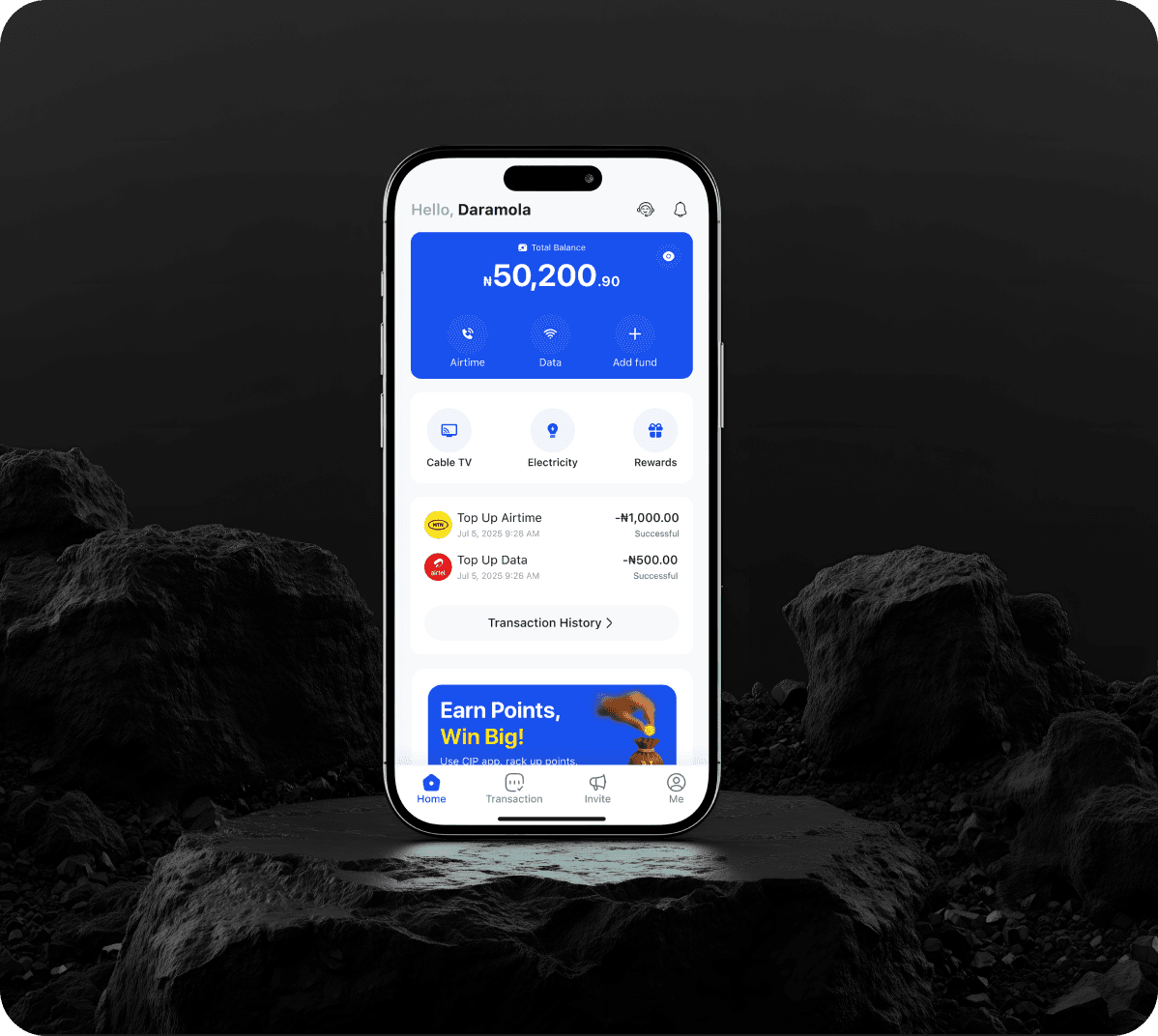
We built CIP TopUp, a live Nigerian platform for airtime, data and bill payments. CIP reports more than 50,000 users across all channels, and the platform runs on infrastructure we designed after auditing the attacks the business had already survived. This is the technical account of what it takes, written for anyone who wants to start or run a VTU platform in Nigeria.
TL;DR: the seven things that actually matter
If you're skimming, here's the whole case study in one table. Everything below expands on it.
- A stack your future team can maintain: We chose React Native and TypeScript because replacing engineers is a real risk in Nigeria, not because it's trendy.
- A distributed backend, not one app: Node and Python services, plus dedicated fraud-detection and problem-detection services.
- Circuit breakers on every provider: Provider downtime is not an edge case. It's a Tuesday.
- Timeout is not failure: Confusing the two silently leaks money every single day.
- Automatic reversal and refund: If you can't reverse a failed top-up automatically, you're running a support queue, not a platform.
- Paranoid input validation: Negative amounts and race conditions will drain your inventory if you let them.
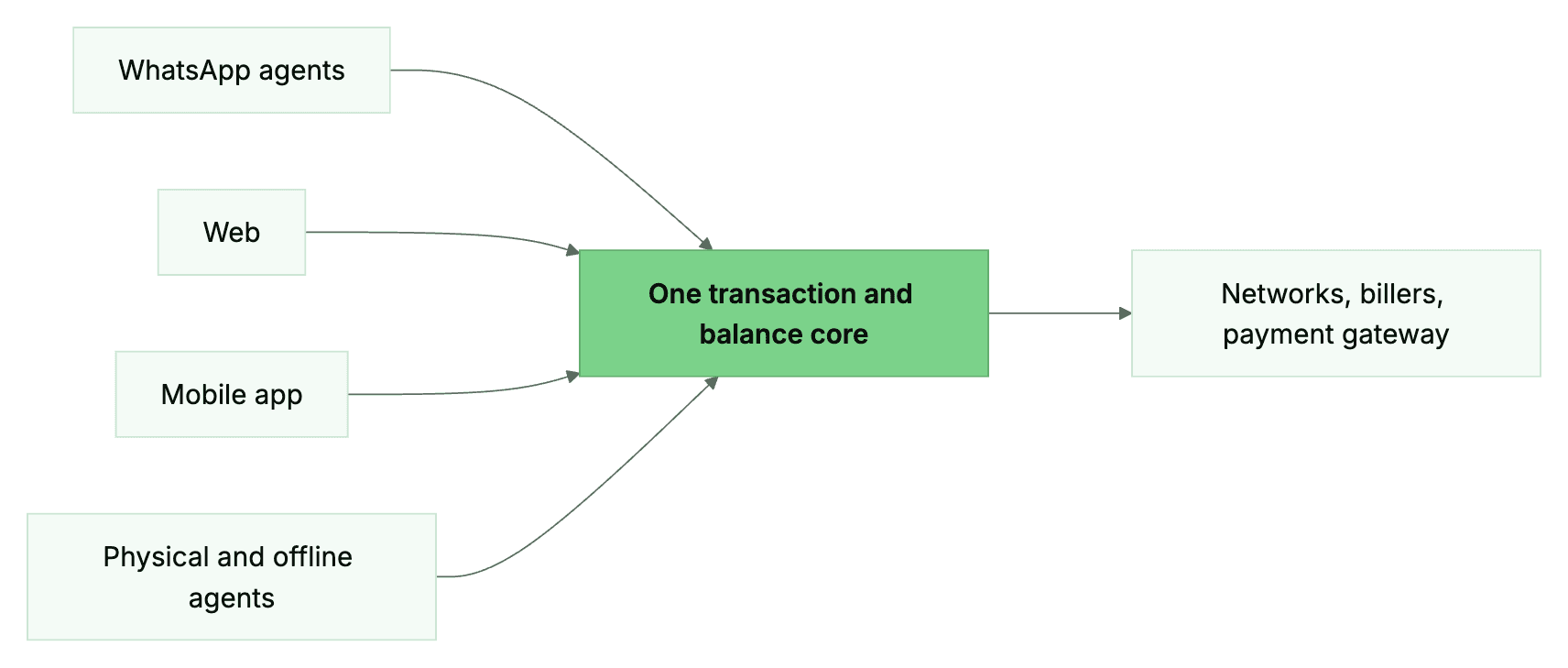
- Multi-channel distribution: WhatsApp agents, web, mobile app and physical.
The opportunity is real, and so is the competition
Nigeria is a mobile-first market, and that's not a marketing line. According to DataReportal's Digital 2026: Nigeria report, there were 165 million cellular mobile connections in the country at the end of 2025, roughly 69% of the population, plus 109 million internet users and a median mobile download speed of 44.96 Mbps. Social media alone grew to 47.8 million user identities.
Translate that into commerce: almost everyone you want to serve already has a phone, and a huge share of them buy airtime, data and utility tokens every single week. That recurring demand is why VTU is one of the most searched online business topics in Nigeria.
But the demand comes with two traps.
Trap one: the margins are thin and volume is everything. Airtime commission is a small percentage, and everyone advertises cheap airtime. You win by moving a lot of transactions reliably, not by being the cheapest by ten naira.
Trap two: a VTU platform is a financial system, not a storefront. You're moving money, tracking balances, and depending on third parties such as networks, billers and payment gateways that fail regularly. If your engineering can't survive that, growth just multiplies your failures.
That second trap is what this case study is really about.
Why we chose React Native and TypeScript
The most important architecture decision in a Nigerian fintech product isn't the database. It's who can maintain it after the launch adrenaline wears off.
Nigeria has a deep, competitive pool of JavaScript and TypeScript engineers. TypeScript is now effectively the default for serious product work, and Stack Overflow's 2025 Developer Survey puts JavaScript as the most-used language with TypeScript tightly behind, while GitHub's Octoverse reported TypeScript becoming GitHub's most-used language. React Native lets you ship one codebase to both Android and iOS while staying in that same ecosystem.
For a business, that translates to something concrete: you can find a replacement engineer. We've watched companies get stuck with a single unavailable developer because they built on a niche stack nobody else in the market could touch. That is an existential risk, not a technical preference.
Our reasoning was:
- Android matters most here. Nigeria is an Android-dominant market, and React Native handles that well.
- One team, one language. The mobile app, the admin tools and parts of the backend all speak TypeScript, so engineers can move between them.
- The talent market is real. A quick look at any Nigerian job board, like MyJobMag and Jooble, shows steady demand for React Native roles, which is exactly what you want when you need to hire.
Was it all upside? No. React Native won't beat fully native code on the most demanding device-level features, and you need discipline to keep the app fast on low-end Android phones with patchy data. We paid for that discipline with careful performance work. But for a business that needs to hire and keep a team in Nigeria, it was the right trade.
The architecture: why it's not "just an app"
The first version of a lot of VTU businesses is a web dashboard with a database and a single integration. It works, until one provider goes slow, or a fraudulent transaction slips through, and then the whole thing drags.
CIP TopUp runs as a distributed system. The mobile app is the visible part. Underneath it, several services do different jobs:
- API and orchestration layer that the app talks to.
- Transaction services that handle top-ups, bill payments and credit movements.
- A credits system that records every balance change as an auditable entry, never as a "just update the number" afterthought.
- Provider adapters for the different upstream services we depend on, including networks, billers and the payment gateway.
- A fraud-detection service that watches for anomalous transaction patterns in real time.
- A problem-detection service that watches the system itself: error rates, provider health and transaction anomalies, so we find issues before customers report them.
We deliberately split these because they fail differently and need to be reasoned about separately. A slow provider should not slow down balance lookups. A fraud spike should not take the whole platform down. And a problem detector that watches everything is what turns a 2am outage into an alert instead of a flood of angry messages.
Here's the mental model:
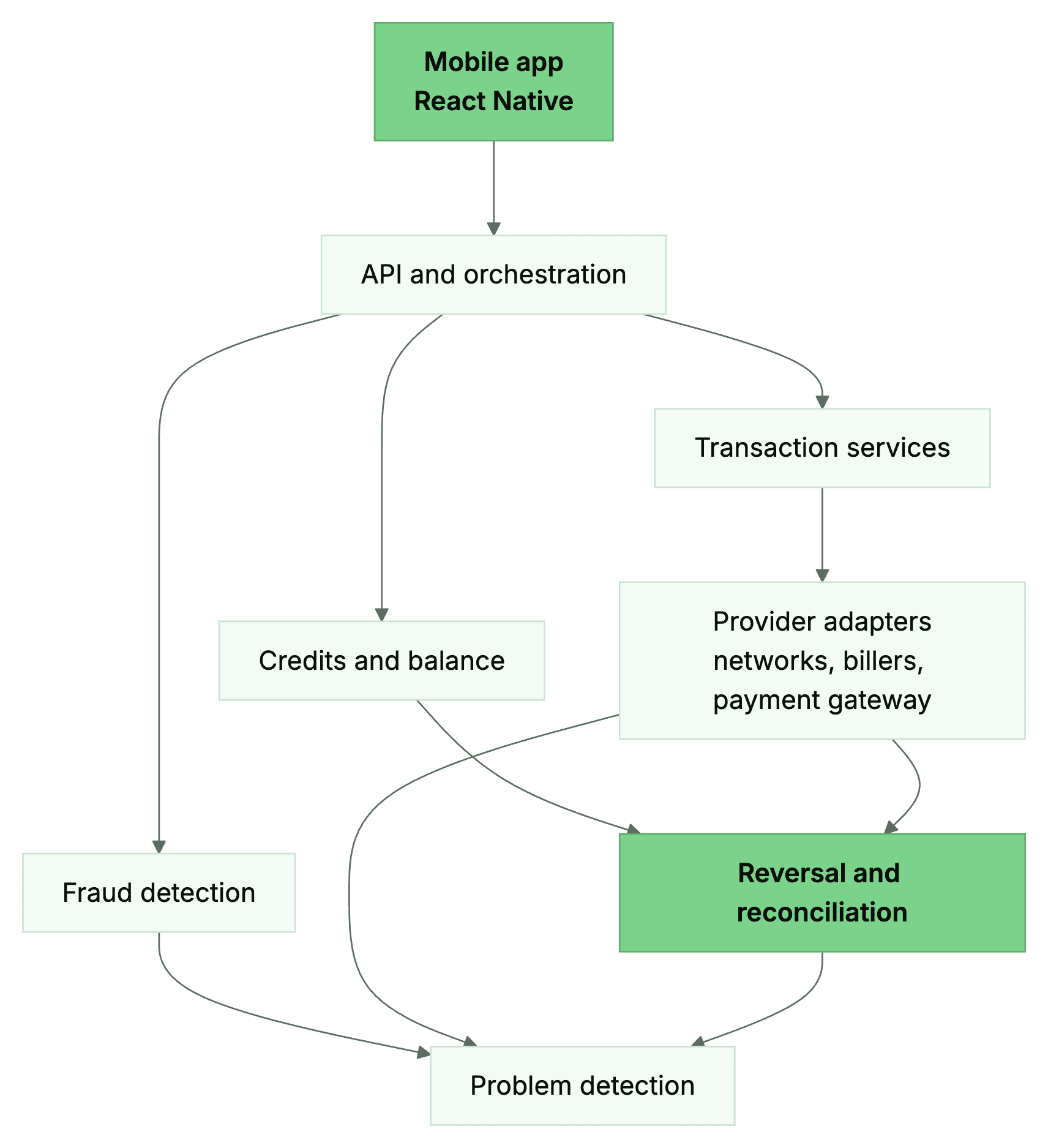
The reconciliation worker is the quiet hero. It continuously compares what our records believe happened against what providers and the gateway say actually happened, and corrects the difference. If you take one architectural idea from this article, take that one: in payments, the truth lives in a reconciliation loop, not in a single successful API response.
The economics of VTU
Our own commercial numbers stay private, but the economics that apply to almost every VTU platform in Nigeria are worth modelling. Treat these as ranges to plan around, not promises.
- Airtime and data are volume businesses. Commission per transaction is small, often low single-digit percentages, and often less on data bundles. You do not get rich on one top-up. You get rich, or broke, on thousands per day.
- Cheap airtime is a race to the bottom. If your only differentiator is price, you're funding customer acquisition out of your own margin. The platforms that last differentiate on reliability and trust, because customers pay a little more when they know the transaction will succeed.
- Float is your working capital. You need money sitting with providers or in your credits system to serve demand. When your float runs out at peak, transactions fail even though your software is fine.
- There are costs everyone forgets: payment gateway fees on customer funding, chargebacks and reversals, reconciliation engineering, and customer support where fraud and failed-transaction tickets dominate.
- Data bundles are not airtime. Their cost and commission structure is different, and the price changes constantly. Systems that hardcode prices break.
- Utility bills add liability. Electricity tokens and cable subscriptions introduce disputes that airtime rarely does.
Rather not build all of this yourself? You can start reselling right away with the CIP API if you're a developer or platform, or get your own branded setup through the CIP Merchant platform without touching the build.
Provider downtime is inevitable, so we plan for it
If you build a VTU platform long enough, every upstream dependency will fail: a network will go slow, a biller will return malformed responses, a payment gateway will time out. This is not a question of if.
Our strategy is the classic circuit breaker pattern, which Microsoft's Azure Architecture Center describes as a way to stop calling a dependency that is likely to fail. A circuit breaker has three states:
- Closed: normal operation, so calls pass through. We count failures.
- Open: too many recent failures, so calls fail fast instead of piling up and exhausting our own resources. We stop hammering the provider.
- Half-Open: after a cool-down, we let a few trial requests through. If they succeed, we close the circuit. If they fail, we re-open it.

We run breakers per provider, not one global breaker. If one network's top-up endpoint is degraded, we should not stop selling another network's data. Since we also work with multiple providers, per-provider breakers let us route around a bad one instead of failing the whole platform.
A few practical rules we learned:
- Fail fast, fail visibly. An open circuit returns a clear "try again shortly" state rather than hanging for 30 seconds. That alone protects the app's responsiveness.
- Separate the policy per dependency. A slow biller and a dead gateway deserve different thresholds. One-size-fits-all breakers either trip too early or too late.
- Alert on state changes. Every time a breaker opens, that's a signal, both to our problem-detector service and to a human. Silent degradation is how you lose customers without knowing.
- Half-open is a flood risk. Letting all traffic through the moment a provider recovers will knock it over again. Let a trickle through first.
The point isn't elegance. The point is that when a provider fails, your platform should degrade gracefully instead of collapsing with it.
The timeout trap: how VTU platforms quietly lose money
This is the section we most want you to read twice, because it's where real money leaks out.
In payments, there are two very different things that both look like "it didn't work":
- A hard failure: the provider clearly rejected the transaction. The customer wasn't credited. You can safely return the money.
- A timeout: you asked the provider to vend airtime, the request took too long, and you didn't get a clean answer. But the customer may well have been credited.
If you treat a timeout as a failure and refund the customer, you've now given them their money back and they got the airtime. The provider will still charge you. You lose money on every single one of those. Do it at scale and it's not a rounding error. It's your entire margin, plus some.
The rule we enforce is simple to say and hard to build:
Never treat "no answer" as "failed." Treat it as "unknown," and resolve it.
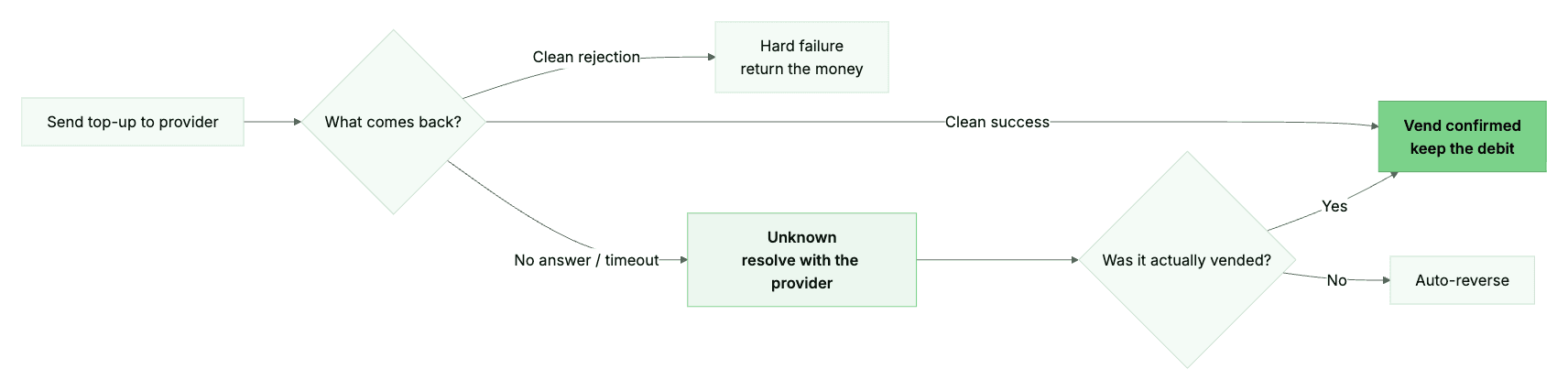
Our approach:
- Every transaction gets a unique idempotency key, so a retry can never create a second top-up.
- When a call times out, the transaction enters an ambiguous state, not "failed."
- A resolver and reconciliation worker then asks the provider, or checks its transaction status, to find out what actually happened, and moves the transaction to its true final state.
- Only genuinely failed transactions are reversed automatically. Successful-but-timed-out ones are left as successful, with the customer's credit correctly debited.
- Ambiguous transactions that can't be resolved within a window get surfaced to support with full context, not silently refunded.
This is the difference between a platform and a leaky bucket. Airtime vending is fast and cheap, which makes it tempting to skip this. Don't. The timeout trap is one of the most expensive mistakes a Nigerian VTU business can make, and it hides in your logs as "successful retries" until reconciliation numbers stop matching.
If you build one thing properly, build your reversal and reconciliation logic.
Or skip the build entirely. The CIP API and the CIP Merchant platform already run circuit breakers, automatic reversal and reconciliation, so you can start reselling today.
The attacks we've actually seen, and how we hardened against them
Before we wrote a line of the new platform, we did something every serious team should do: we asked the client what had already happened to them. Every platform that has moved real money has a history: chargebacks, fake funding, exploited inputs, angry customers, people who found a bug and milked it. We collected those stories and patched the classes of problem they represented, not just the exact symptom.
Then we launched a new platform, and found new patterns anyway. Security is not a checklist you finish. It's a posture you maintain.
Here are the attack categories that mattered.
Negative and malformed amounts
One of the earliest, most common classes of attack is dead simple: what happens if a user enters a negative number as the amount?
If you don't validate it, the arithmetic can invert. Instead of debiting the customer's credit, you credit it, and in the worst case you also vend the airtime. The attacker gets value twice. This isn't sophisticated. It's the first thing a curious user tries.
The fix is boring and non-negotiable: validate every amount server-side and client-side, reject non-positive values, enforce sensible minimums and maximums, and never trust anything the client sends. Client-side validation is a convenience for honest users, not a security control.
Race conditions
The other classic is the race condition: firing two requests at the same instant so that a balance is checked twice before either transaction debits it. Done deliberately, this is a way to overdraw an account or double-spend a credit balance.
Race conditions are subtle because in testing everything looks fine. They only appear under concurrency, which is exactly when real money is moving. We handle them with server-side atomic operations and locking around balance changes, an idempotency key per attempt, and records that make it impossible to debit a credit balance twice for the same transaction. The credit balance is the source of truth, and every balance change is transactional.
Input fuzzing and validation hunting
Attackers don't only attack your business logic. They attack your inputs. They'll send malformed strings, absurd precision, wrong types and boundary values, looking for the one field that isn't validated server-side. Any field that leaks an error, reveals internal data, or triggers unexpected behaviour is a foothold.
We treat every external input as hostile, validate on the server first, and prefer allow-lists over blocklists. We also invested in the audit and logging layer so that when something anomalous happens, we can reconstruct exactly what was sent, when, by whom, and what the system did about it.
Leaks that let someone cart away inventory
Sometimes the flaw isn't in one input. It's a leak in an endpoint, a response, or a shared credential that lets an attacker drain platform inventory, such as airtime and data held with providers, without paying for it. These are the scariest because they can scale instantly.
Our defences here are about least privilege and detection: services only get the access they need, sensitive data doesn't leave the server, and the fraud-detection service watches for transaction patterns that look automated or abnormal so we can cut them off before they drain anything.
The principle behind all of it
You cannot imagine every attack. So instead of trying to, we build the system to assume the worst: validate everything server-side, make money movement atomic and idempotent, log everything, and add an independent service whose entire job is to notice when behaviour stops looking human.
Fraud, phishing and protecting your users, not just your platform
There's a second front that gets far less attention: your users get attacked, not just your platform.
Nigeria has a high incidence of phishing and social-engineering fraud. Attackers impersonate support, send fake links, and manipulate customers into handing over access or approving transactions. If your platform becomes a place where users lose money to social engineering, word spreads and your reputation is gone, even if your code was never breached.
A few principles we build around:
- Assume support is a targeted channel. Treat support and reset flows as high-risk, because that's where impersonators operate.
- Make reset flows deliberately conservative. We intentionally block certain reset actions inside the app and route them through a controlled channel instead. It adds friction, and friction is exactly what stops a fraudster who has half a user's information. We'd rather a legitimate user contact us than let an attacker self-serve their way into an account.
- Log and audit everything. When a dispute happens, the audit trail is what protects both the customer and the platform.
- Protect the user, not just the balance. Clear in-app messaging about what we will and won't ask for, such as never asking for a password or OTP, does more than any single technical control.
The uncomfortable truth: the weakest link is rarely your cryptography. It's a customer being tricked, or a small unvalidated field. Build for both.
Distribution channels
Launch your own VTU platform without rediscovering our mistakes
Here's the part most case studies won't tell you: you don't have to build all of this from zero.
We've already built it, hardened it, and learned the expensive lessons above. So we packaged it. CIP Topup for merchants lets you register on CIP and get your own setup, including your own website, your own app, and access to the agent network, without having to rebuild the circuit breakers, the reversal logic, the fraud detection, and the reconciliation that took us years to get right.
Three ways to work with CIP:
- CIP API for developers and platforms that want to plug into airtime, data and bill payments.
- CIP Merchant platform for businesses that want their own branded website, app and agent network.
- CIP Affiliate and agent program for promoters and agents who want to earn on every transaction they bring in.
Starting a VTU business is hard enough. You shouldn't have to rediscover the timeout trap and the negative-amount bug on your own money. We've built this and we know the risks. Build with us.
Request your own VTU platform →
Results
- Total users: 50,000+ across all channels: Reported by CIP, September 2026
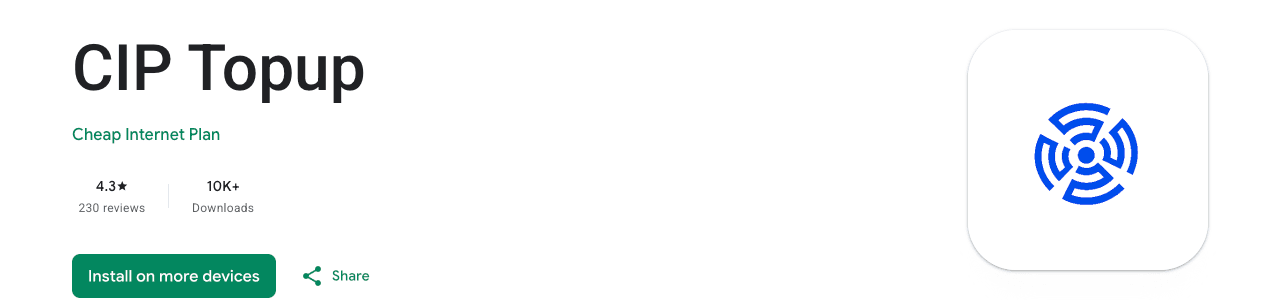
- Google Play downloads: 10,000+: Public Play listing, September 2026
- Google Play rating: 4.3★ from 230 ratings: Public Play listing, September 2026
- Platform status: Live since 2022: Public app-store release date
- Transaction growth: +300% in the first quarter: Reported by CIP
The Google Play figures are public and were checked in September 2026. The total user count and transaction growth are CIP's own reported numbers. Review volume for a Nigeria-first product sits mostly on Google Play, which is where our users are.
What we'd do differently
Here's what we'd change if we started again.
- We'd build the reconciliation loop even earlier. We knew about the timeout trap intellectually. We still had to earn the lesson in production. If you're starting, build reversal and reconciliation on day one, before you have volume.
- We'd treat fraud detection as a product, not a feature. The first version added it where we remembered to. The mature version is a service that watches everything and has its own on-call owner.
- We'd design our records for audits from the start. Retrofitting proper records is painful. Model every balance change as an immutable entry from the beginning.
- We'd document the why as carefully as the what. When you have a distributed system, the reason a breaker is tuned a certain way matters more than the code. Write it down.
- We'd test concurrency far more aggressively. Race conditions don't show up in happy-path testing. We now test money movement under load as a matter of course.
None of these are exotic. They're just the things that look optional until they're not.
FAQ: the questions people actually ask about VTU
Is a VTU business still profitable in 2026? Yes, for operators who treat it as a volume-and-reliability business. Margins per transaction are thin, so profit comes from high success rates, low support costs and multiple channels. If you're only competing on price, it's brutal.
How much does it cost to start a VTU platform? It depends on whether you're reselling on an existing platform or building your own. Reselling is cheap and fast, and the quickest way in is the CIP API or the CIP Merchant platform. Building your own is a real software project with ongoing engineering, covering the app, the backend, security, reconciliation and the people to run it. The cost that surprises beginners is maintenance and support, not the initial build.
What's the best VTU API provider? There's no universal best. You want one with good uptime, clear pricing, honest transaction status so you can tell a timeout from a failure, and reliable reconciliation data. Price matters, but a provider that can't tell you the truth about a transaction will quietly cost you more than the one with a slightly higher rate.
How do I stop fraud like negative amounts? Validate everything on the server, reject non-positive amounts, use allow-lists, make money movement atomic and idempotent, and add an independent fraud-detection service. Assume every input is hostile.
What happens when a top-up times out after the customer pays? Treat it as unknown, not failed. Resolve it with the provider, and only auto-reverse genuine failures. Never blanket-refund timeouts, because that's how you pay twice.
Do I need an app, or is a website enough? Start with the channels your customers actually use. In Nigeria that's often web and WhatsApp, with an app for repeat users. Don't build the app first just because it feels prestigious.
How do I get users and agents? Agent networks and WhatsApp distribution matter. Give resellers a reason to promote you: margin, reliability, fast settlement and frictionless onboarding.
What tech stack should I use? Pick a stack you can hire for and maintain in your market. We chose React Native and TypeScript for exactly that reason. A niche stack that only one developer understands is a business risk.
How do you handle provider downtime? Circuit breakers per provider, graceful degradation, fast failures instead of long hangs, and automatic reversal for genuine failures. Downtime is guaranteed. Collapsing with it is optional.
Sources and further reading
- DataReportal, Digital 2026: Nigeria for mobile, internet and social media context.
- Microsoft Azure Architecture Center, Circuit Breaker Pattern for the resilience pattern we use for providers.
- Stack Overflow, 2025 Developer Survey: Technology for the language adoption behind our stack choice.
- GitHub, Octoverse for TypeScript usage trends.
Build with us
If you're serious about launching an airtime, data and bill-payment platform, and you'd rather skip the expensive mistakes, CIP Topup for merchants gives you your own website, app and agent network on infrastructure we've already hardened.
Three ways to work with CIP: plug into the CIP API, launch your own branded setup on the CIP Merchant platform, or earn as a promoter through the CIP Affiliate and agent program.
We've built this and we know the risks. Build with us.
Your Next Big Project with Darphiz
Book a free 30-minute project session or drop us a quick message. Whether you're refining an idea or building from scratch, we'll help you make it real.
Book a 30-min Project Discovery Call
Turn half an hour into the start of something powerful.
What we'll cover:
A quick introduction
Understanding your project goals
Pinpoint how we can help you build faster
Let's Talk About Your Project
Share a few details about what you're building, and we'll get back to you with ideas, timelines, and next steps.