

Most guides to VTU providers compare discount percentages. That is the least useful comparison you can make.
Your provider sits between you and your customers. When it fails, you take the blame. When it cannot tell you the truth about a transaction, you lose money quietly. The provider you choose shapes your reputation more than your logo or your prices.
This guide covers how to choose one properly. It is written by a team that has built and run a VTU platform, so it focuses on the things that actually break.
What is a VTU API?
A VTU API is the interface your app uses to buy airtime, data and pay bills through a provider. You send a request with the phone number, the network or biller, and the amount, and the provider passes it upstream and returns a result. That is the whole exchange.
Everything you care about sits on top of that exchange: your balance, your reversals, your support queue and your reputation. That is why the provider you pick matters so much. The interesting question is not whether it can buy airtime, because most can. It is what happens when the exchange goes wrong.

Your provider is your reputation
Customers do not blame the network when a top-up fails. They blame you. From their side, they paid you and did not get their airtime, or they got it and you refunded them anyway.
That means the provider decision is not just a cost decision. It is a reliability decision, a data decision, and a trust decision.
A cheap provider that fails often and hides transaction truth will cost you more than a slightly more expensive provider that is honest and stable.
The criteria that actually matter
Here is what to evaluate, roughly in order of importance.
1. Uptime and stability. Does it hold up at peak times, when network traffic spikes and everyone is buying data at once? Ask for uptime history, not marketing claims.
2. Honest transaction status. Can it clearly tell you the difference between a hard failure and a timeout? This one matters so much that it gets its own section below.
3. Reconciliation data. Can you pull the true state of transactions after the fact, so you can resolve anything that ended in an unknown state? Without this, you cannot cleanly reconcile your books.
4. Pricing transparency. Are the rates and fees clear, and do they change without notice? Hidden fees and silent rate changes erode margin.
5. Coverage. Does it cover all the networks, data bundles and billers you need, including the ones your customers ask for?
6. Support that responds. When something breaks at 11pm, is there a real human reachable? Ask about their escalation process before you sign up.
7. Documentation and sandbox. Can you integrate and test without risking real money first? Ask to see the docs before you sign up, and expect them to be free and public. You can see what a clear integration flow looks like in the CIP API documentation.
8. Rate limits and throughput. Can it handle the volume you plan to do, and does it degrade gracefully when you grow?
The one question to ask every provider
Ask this: when a request times out, how do you help me find out what actually happened?
This is the difference between a healthy platform and a leaky bucket.
When you send a top-up and get no clean answer, two things may be true. The transaction may have failed, or the customer may have been credited even though you did not get a response. If your provider treats both as failures, and you refund on both, you will pay twice for every timeout.
A good provider gives you a way to resolve that unknown state. Developers call this a requery, and it is the single most useful feature to look for. A requery endpoint lets you ask the provider for the true status of a transaction after the fact, even when the original request never returned. A provider should also support webhooks so it can push status changes to you, and provide reconciliation data you can reconcile against. A provider that leaves you guessing is a provider that will cost you money every month.
We explained exactly why this matters in the CIP case study.
What we have measured at CIP
This is where most guides stay theoretical. Here is what we actually see running a live platform.
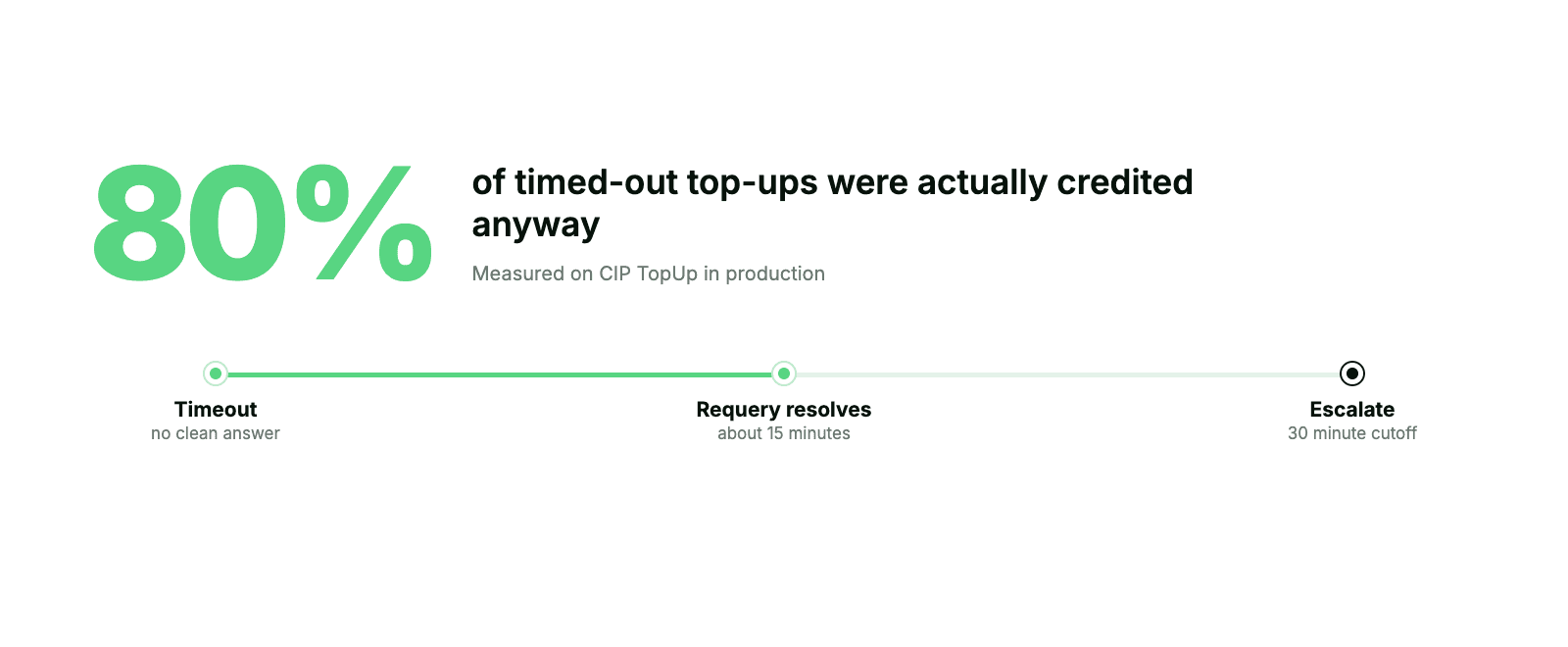
- When a top-up times out, roughly 80 percent of the time the customer was credited anyway. That is why you never refund a timeout. You resolve it.
- A requery usually returns a definitive answer within about 15 minutes. Some transactions stay pending indefinitely, so we treat 30 minutes as the cutoff before a transaction is escalated instead of resolved automatically.
- Timeouts cluster. They spike at peak hours, and they spike again right after a provider changes something, such as pricing, the API structure or plan codes. A quiet day can turn into an incident because a provider shipped a change you did not know about.
Those three facts alone explain most of the money a careless VTU operator loses.
Reliability benchmarks for a VTU provider
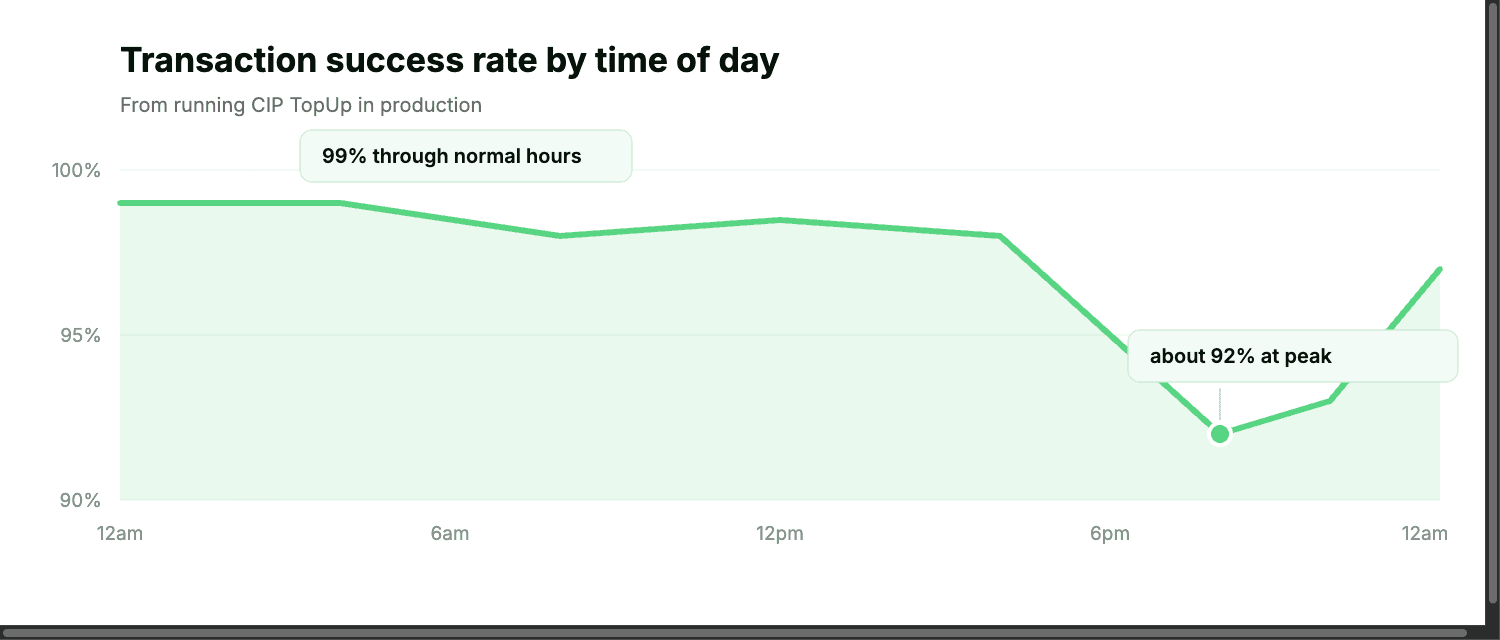
Ask what success rate a provider actually delivers, and hold it to these ranges.
- Normal hours, roughly midnight to 4pm: expect around 99 percent.
- Peak hours, roughly 8pm to 10pm: around 92 percent is realistic, and acceptable.
- Outside those ranges is a warning. A provider sitting in the mid 80s at peak is not a discount. It is a support queue and a reputation problem.
Use these as your baseline when you test. If a provider cannot stay near them, the cheapest rate in the market will not save you.
Treat webhooks as notifications, not truth
Most providers in this market either do not offer webhooks at all, or offer them with weak security and no way to verify that a request actually came from them. That is the reality, whatever the marketing says.
So treat a webhook as a notification, not a source of truth. When one arrives, requery the transaction and confirm the real status before you act on it. The requery, not the webhook, is what protects your money. If a provider offers properly signed webhooks you can lean on them more, but you should still requery anything that matters.

How onboarding and API keys work
Most Nigerian providers onboard you roughly the same way. You create an account, sometimes complete light verification, and generate an API key. Some require you to fund a wallet before you can go live. A few offer a test or sandbox mode with fake data so you can integrate without spending real money.
A few details tell you a lot about how serious a provider is:
- Test and live keys are separate. You should never be forced to test with real money in production.
- Keys can be rotated and scoped. If a key leaks, you need to revoke it without rebuilding everything.
- The docs are reachable before you pay. If you must pay a fee just to read the API documentation, treat it as a warning sign. Good providers publish their docs publicly.
- Webhooks are signed, or at least verifiable. Many providers in this market are neither, which is why we treat webhooks as notifications and always requery.
If the onboarding feels opaque, the support probably will be too.
How pricing really works
Most providers price in one of a few ways. Understand the model before you compare headline numbers.
- Discount on face value. You buy airtime at a discount and sell at face value, or slightly below. The discount is your margin. Small discounts mean volume is everything.
- Funding fees. Fees charged when you fund your wallet or account with the provider. Easy to overlook, and they add up.
- Settlement terms. How and when money moves between you, the provider and the customer.
- Per-biller pricing. Some services, electricity and cable especially, have their own fees and structures.
- Hidden costs. Rate changes, failed transaction handling, and minimum volumes can all change the real cost.
The lowest headline rate is not always the cheapest provider. A provider with a slightly higher rate but reliable reconciliation and fewer failures usually wins.
Red flags
Watch for these when you evaluate a provider.
- It cannot clearly explain how it handles timeouts and reversals.
- Rates are vague, or change without notice.
- There is no way to pull transaction history or reconcile.
- Support is slow or only reachable during office hours.
- No sandbox, so you must test with real money.
- It overpromises on uptime but has no track record you can verify.
- It hides the fact that it is itself reselling from someone else, so you inherit an extra layer of failure.
None of these are automatically fatal, but each one raises your risk. Stack a few of them and you are building on sand.
Scam and trust signals
Nigeria's VTU space has a scam problem, and it usually shows up as platforms that take your wallet funding and then stop responding. Before you send money, check the basics.
- Is there a registered business or a verifiable address behind the platform?
- Is there a written refund and reversal policy you can actually read?
- Do the API docs exist publicly, or must you pay before you can read them?
- Is there any public track record, community presence or third-party discussion?
- Does support answer a hard question before you pay?
- Are you being pushed to fund a large wallet before you can test anything?
None of these prove a provider is bad on their own. But a provider that fails several of them is not one you should trust with your customers' money.
An evaluation checklist
Use this to compare providers side by side.
- Peak-time uptime: Failures at peak cost you the most customers
- Timeout and failure handling: Decides whether you leak money
- Requery and webhook status: Lets you resolve timeouts and receive updates
- Reconciliation access: Lets you resolve unknown states
- Rate and fee transparency: Protects your margin
- Network and biller coverage: Matches what your customers ask for
- Support reachability: Matters when things break
- Sandbox availability: Lets you test safely
- Rate limits and scaling: Supports your growth
Score each provider on these before you let price decide for you.
A weighted scorecard
Not every criterion deserves equal weight. Here is a starting weighting, based on what actually hurts operators most.
- Timeout and requery handling: 25%: This is where money leaks
- Uptime at peak: 25%: Failures at peak cost the most customers
- Reconciliation data: 15%: Lets you resolve unknown states
- Pricing transparency: 10%: Protects your margin
- Coverage: 10%: Matches what customers ask for
- Support reachability: 8%: Matters when things break
- Docs and sandbox: 5%: Speeds up integration
- Rate limits and scaling: 2%: Supports your growth
Score each provider from 1 to 5 on every row, multiply by the weight, and add the totals. The highest total wins, not the cheapest rate. Copy the table into a spreadsheet and run your shortlist through it side by side.
How to test a provider before you commit
Do not judge a provider from a sales call. Test it.
- Integrate in a sandbox if one exists, and run realistic transactions.
- Start with small volume. Move a limited amount of real traffic first.
- Deliberately test failure. Submit a bad amount, a duplicate request, and a request likely to time out. See what the provider returns.
- Reconcile daily. Compare your records against the provider's data. If they never match cleanly, that is your answer.
- Watch at peak. Performance at 9pm on a busy day tells you more than performance at 10am.
- Ask support a hard question. Time how long it takes to get a real answer.
If the provider passes these, great. If it struggles with reconciliation or timeouts, walk away, however attractive the rate looks.
Build vs buy, honestly
If you use a provider directly, you still own the hard parts: idempotency, retries, reversals and reconciliation. The provider gives you inventory. It does not run your business.
If you are building, you can integrate directly and see exactly how the pieces fit in the CIP API documentation. And if you want to skip the infrastructure work, a merchant or platform offering, like CIP Topup for merchants, gives you the whole stack including the provider integrations, the reversal logic and the reconciliation. That is a real shortcut for operators who would rather sell than build.
FAQ
Is the cheapest VTU API the best choice? Almost never. The cheapest rate is meaningless if the provider fails often or cannot help you resolve timeouts. Compare total cost, including failed transactions and support load.
What is the best VTU API provider in Nigeria? There is no universal best. The right one for you depends on coverage, reliability, reconciliation and support for your volume. Test providers against the checklist above.
How do I integrate a VTU API? Usually you connect to the provider's endpoints, send top-up or bill payment requests, and handle the responses and status checks. The integration is the easy part. Handling retries, timeouts and reconciliation properly is the work.
What is a requery? A requery is a request you send to the provider to find out the true status of a transaction you already submitted. It is how you resolve a transaction that timed out or returned no clean answer, so you can decide whether to keep the debit or reverse it.
How long does a requery take? In our experience, about 15 minutes for most transactions. Some stay pending indefinitely, so we treat 30 minutes as the cutoff before escalating instead of waiting forever.
Are VTU provider webhooks reliable? Often not. Many providers do not send them at all, and those that do usually have weak security with no way to verify the sender. Treat webhooks as notifications and requery the transaction for the real status.
How do I get a VTU API key? Usually you create an account with the provider, complete any verification they require, and generate a key from their dashboard. A good provider also gives you a separate test key so you can integrate before you touch real money.
What if a provider charges for API documentation? Treat it as a warning sign. Public documentation is normal in this space, and paying before you can even read the docs tells you little about reliability. A provider confident in its product publishes the docs and lets them sell the service.
What should I do when a transaction times out? Treat it as unknown, not failed. Resolve it with the provider, and only reverse transactions that genuinely failed. Never blanket refund timeouts.
Can one provider handle everything? Often not. Many operators use a primary provider and a backup for resilience. That is another reason per-provider handling matters in your architecture.
Related reading
- How to start a VTU business in Nigeria.
- VTU app architecture: credits, retries and reconciliation.
- Team Darphiz, How we built CIP TopUp.
Or skip the provider headache
Choosing and integrating providers is real work. If you are building, start with the CIP API documentation. If you would rather start selling, CIP Topup for merchants gives you a platform, an app and an agent network on infrastructure we have already hardened, including the provider integrations and reconciliation.
We built this and we know the risks. Build with us.
Stay in the loop
Get the latest updates and insights delivered to your inbox.
More like this
AI Video in Nigeria Is Either Brilliant or a Joke. There Is No Market for the Middle.
AI video is bimodal: it either earns praise or gets laughed at, and the middle sells nothing. Here is what Nigerian businesses should do, why familiar faces beat better models, and why the real moat is infrastructure, not the prompt.
Read ArticleWhatsApp Is Charging Nigerian Businesses ₦10 a Message. We Run a Full App on Two Flows.
From October 1, 2026 Meta charges Nigerian businesses per message for WhatsApp replies. Here is who actually pays, why ₦10 a message breaks low-margin businesses, and the two WhatsApp Flows we use to run a whole app in one message.
Read Article