

If you have spent any time looking into online businesses in Nigeria, you have seen the pitch for VTU. Sell airtime, data, electricity tokens and cable subscriptions. Make money from every top-up. Set it up in a weekend.
Some of that is true. Most of it leaves out the parts that decide whether your VTU business survives its first year.
This guide is the practical version. It covers the models you can choose, what it actually takes to start, how the money really works, and the three things that quietly kill VTU businesses. It is written from the perspective of a team that has built and run one, which is why we are honest about the parts the sales pages skip.
If you want the deeper build story, we wrote it up separately: what launching an airtime and bill payments platform really takes.
The opportunity is real
Nigeria is a mobile-first market. According to DataReportal's Digital 2026: Nigeria report, there were around 165 million mobile connections at the end of 2025, roughly 109 million internet users, and a median mobile download speed of about 45 Mbps.
Translate that into commerce. Almost everyone you want to serve already has a phone, and a large share of them buy airtime, data and utility tokens every single week. It is recurring demand, which is exactly what you want in a business.
The catch is that recurring demand also means recurring competition.
Decide which business you are actually starting
This is the step most people skip, and it changes everything else. There are three very different businesses people call a VTU business.
- Reseller: You sell on top of someone else's existing platform: Low: Low
- White-label: You use someone else's infrastructure under your own brand: Medium: Medium
- Your own platform: You build or own the technology that runs everything: High: High
Reselling is the fastest way to start. You sign up, get access, and start selling to the people around you. Your margins are thin and you do not control reliability, but you learn the business with very little risk.
White-label is the middle path. You get your own brand, website, app and often an agent network, running on infrastructure someone else maintains. You get most of the upside of owning a platform without carrying the engineering burden.
Building your own platform gives you full control and the best long-term economics, but it is a real software project. You are now responsible for uptime, failed transactions, fraud and reconciliation. Most people who start here underestimate that.
If you are a beginner, the honest advice is to start with reselling or white-label, learn how the money and the failures work, and only build your own platform once you understand what you are building. You can skip years of expensive mistakes by starting on infrastructure that already works. That is exactly why we packaged CIP Topup for merchants.

What you actually need to start
Strip away the marketing and a VTU business needs the same things whether you are reselling or building.
- A source of inventory. Access to airtime, data and bill payments through a provider or platform.
- A way to collect money. A payment gateway, a bank account, or both.
- Floating capital. Money sitting with your provider or in your system so you can serve demand without running dry at peak.
- A place to sell. A website, an app, a WhatsApp setup, or an agent network.
- Support. Someone to handle failed transactions, refunds and questions. This is bigger than beginners expect.
- A clear model. You need to know which of the three businesses above you are actually running.
Notice that "build an app" is not at the top of the list. The app is the shopfront. The business is inventory, payments, float and support.
The economics, honestly
Here is the part the sales pages avoid. Airtime commission per transaction is small, often a low single-digit percentage, and usually less on data bundles. You do not get rich on one top-up. You get rich, or broke, on thousands per day.
That means a few things follow.
You win on volume and reliability, not on being the cheapest. If your only differentiator is price, you are funding customer acquisition out of your own margin. Customers pay a little more when they know the transaction will succeed.
Float is your working capital. You need money available to serve demand. When your float runs out at peak, transactions fail even though your software is fine.
Data bundles are not airtime. Their cost and commission structure is different, and prices change constantly. Anything that hardcodes prices will break.
There are costs everyone forgets. Payment gateway fees on customer funding, chargebacks and reversals, reconciliation, and customer support all eat into margin. Budget for them from day one.
The practical takeaway: model your business on transactions per day and success rate, not on the discount you advertise.
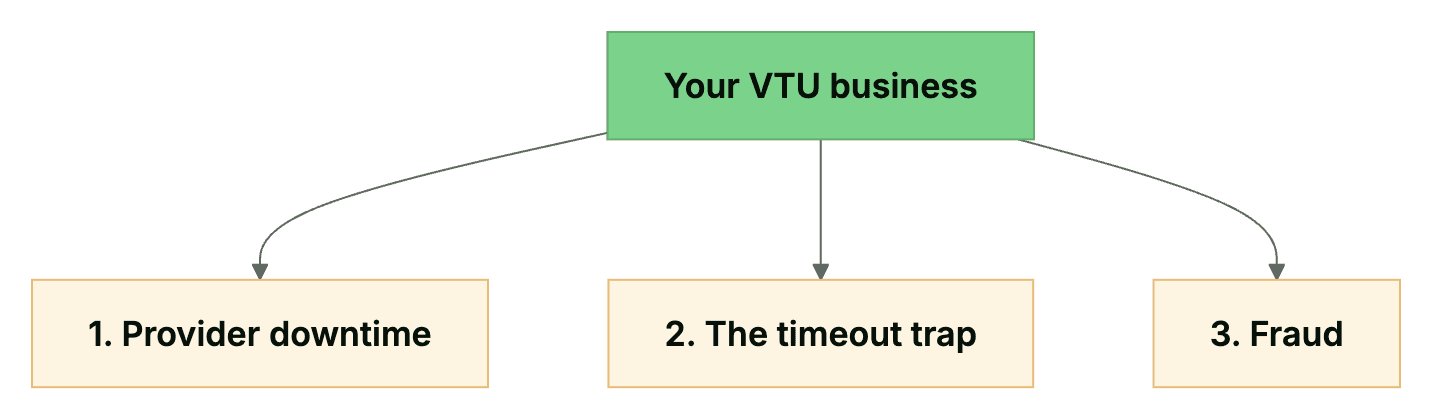
The three things that quietly kill VTU businesses
Most VTU businesses do not die because of competition. They die from these.
1. Provider downtime. Networks slow down, billers return strange responses, gateways time out. This is not a question of if. If your platform collapses whenever a provider wobbles, your customers leave.
2. The timeout trap. This is the expensive one. When a top-up times out, the customer may have already been credited. If you treat that timeout as a failure and refund the customer, you have given them their money back and they still got the airtime. Do that at scale and you quietly lose your entire margin. We broke this down in detail in the CIP case study.
3. Fraud. Negative amounts, race conditions, validation exploits and phishing are all real. A platform that moves money is a target. Assume every input is hostile and build accordingly.
If you resell or use a white-label platform, you are trusting someone else to solve these. That is fine, but ask them how they solve them before you send them customers.
Choose your channels
VTU in Nigeria is not app-only. The volume moves across several channels, and the platforms that grow support more than one.
- WhatsApp agents. A large share of volume moves through resellers and agents who serve communities. They live on WhatsApp.
- A website. Works for users on shared or low-storage phones, and for merchants who want to offer services without an install.
- A mobile app. The best experience for repeat users.
- Physical and offline agents. Shops and in-person resellers still capture demand an app cannot reach.
You do not need all of them on day one. Start with the one your customers already use, then add channels as you grow.
A realistic launch path
- Pick your model. Reseller, white-label, or your own platform.
- Choose a provider or platform you can trust. Reliability and honest transaction status matter more than the headline rate.
- Set up your collection method. Gateway and bank account, tested properly.
- Fund your float. Start small and grow it as you understand demand.
- Set up one sales channel. WhatsApp or a simple website is usually enough to begin.
- Write down how you will handle failures. Refunds, reversals and support. Decide this before you need it.
- Start selling and watch two numbers. Transaction success rate and reconciliation. These tell you if the business is healthy.
- Add channels and agents once the basics are stable.
- Reinvest. Grow float and inventory, not just marketing.
Nine steps sounds simple. The businesses that survive are the ones that take steps five through eight seriously.

FAQ
Is a VTU business still profitable in 2026? Yes, for operators who treat it as a volume and reliability business. Margins per transaction are thin, so profit comes from high success rates, low support costs and multiple channels. If you only compete on price, it is brutal.
How much does it cost to start? Reselling is cheap and fast. Building your own is a real software project with ongoing engineering and support costs. The cost that surprises beginners is maintenance and support, not the initial setup. See what it really takes.
How much float do I need? Enough to serve your peak demand without running dry. Start small, track how often you hit zero, and grow it from there. Running out of float at peak is one of the most common causes of failed transactions.
Do I need a licence? It depends on what you actually do, especially if you hold customer funds. Many operators are agents, aggregators or merchants on top of licensed infrastructure. Check your specific model with a professional before you scale.
Do I need to build an app? No. Start with the channel your customers already use. In Nigeria that is often WhatsApp and a simple website, with an app for repeat users later.
Can I start without technical skills? Yes, if you resell or use a white-label platform. You still need to understand the economics and support, but you are not writing code.
Sources and further reading
- DataReportal, Digital 2026: Nigeria.
- Team Darphiz, How we built CIP TopUp.
- How to choose a VTU API provider.
- VTU app architecture: credits, retries and reconciliation.
Start on infrastructure that already works
If you want to own your own VTU brand without rebuilding the hard parts, CIP Topup for merchants gives you a website, an app and access to an agent network on infrastructure we have already hardened.
We built this and we know the risks. Build with us.
Stay in the loop
Get the latest updates and insights delivered to your inbox.
More like this
WhatsApp Is Charging Nigerian Businesses ₦10 a Message. We Run a Full App on Two Flows.
From October 1, 2026 Meta charges Nigerian businesses per message for WhatsApp replies. Here is who actually pays, why ₦10 a message breaks low-margin businesses, and the two WhatsApp Flows we use to run a whole app in one message.
Read ArticleAI Video in Nigeria Is Either Brilliant or a Joke. There Is No Market for the Middle.
AI video is bimodal: it either earns praise or gets laughed at, and the middle sells nothing. Here is what Nigerian businesses should do, why familiar faces beat better models, and why the real moat is infrastructure, not the prompt.
Read Article