
An AI automation agency in Nigeria builds and maintains software that runs a business process without a person doing the repetitive part. You hire one when the process is worth fixing, is not worth a full-time engineer, and the cost of doing it by hand is already showing up in your payroll or your lost sales.
A project runs from a few hundred thousand naira for one workflow to several millions for a connected system. The variable that decides where you land is not the AI. It is how messy your data is.
One thing to clear up first. There are two audiences for this phrase. If you want a process in your own business fixed, keep reading. If you want to start your own automation agency, you are looking for a course rather than a supplier, and the two have nothing in common beyond the wording.
What an agency actually does
Good agencies do four things, in this order.
- Process discovery. They sit with the people doing the work, write down the trigger, the steps and the exceptions, and find where the time goes. Clients undervalue this step, and it decides whether the project works. On a wholesale business it starts with a week of exported Telegram messages: what buyers ask, who asks it, and how often the same answer gets typed out by hand.
- Integration and build. They connect your existing tools, meaning your spreadsheet, your accounting software, your WhatsApp or Telegram channel, your payment provider, your POS. Most of the effort sits here.
- AI layer. They add the models that read text, images or voice and make the small decisions. This is the smallest and cheapest part of the build.
- Run and maintain. They monitor failures, fix what breaks when a platform changes, and adjust as your business changes. This is billed monthly and it is not optional, whatever a proposal implies.
A supplier who only does step three and calls it a service is selling you a demo with a subscription attached.

The services worth paying for
Nobody needs all ten. The first three are where most Nigerian sellers start, because that is where their messages come from.
- Enquiry response on the channel you already sell on. Telegram, WhatsApp, or your website. Price, availability, the delivery cost for the buyer's own area, and "are you genuine", answered from your live records, with complaints, refunds and discount requests pushed to a person.
- Order notifications. When a buyer pays and hears nothing for two days, they ask. A status message the buyer did not have to request is the cheapest support you can buy. Where delivery between states is unreliable, it is also the difference between a patient buyer and an angry one.
- Stock control that does not oversell. During a sale, a generic website builder will sell a line twice, because the stock figure updates after payment rather than at order time. The cost lands as refunds, public apologies, and an influx of messages at the moment you have least time to answer them. This is a build question, not a settings toggle.
- The collection queue. Buyers who paid separately and want one trip to the park to save the waybill charge. The system holds those orders, keeps the stock claimed, nudges the buyer on a schedule, and releases the stock back when they never show up. Uncollected boxes are stock piling you are already paying for.
- Dispatch coordination. The day's confirmed orders grouped by area, state and LGA. A rider manifest drafted and each rider sent their list. The system follows up with a rider who goes quiet rather than passing the silence on to the buyer.
- Payment reconciliation. Transfers matched to open orders, with the wrong-amount and missing-reference cases flagged rather than discovered at month end.
- Document processing. Receipts, invoices and delivery notes read and turned into records, with anything uncertain flagged for review.
- Data sync and reporting. Your POS, bank records, accounting software and spreadsheets kept consistent, with a monthly report that builds itself.
- Internal workflow automation. Approvals, task routing and onboarding moved out of WhatsApp groups into something with a status and an audit trail.
- Voice and receptionist systems. A second phase, and only where they fit, because the running costs and the accent problem need testing on your own callers first.
What a build costs, whoever you buy it from
These are planning shapes rather than quotes. What sits inside each one varies more than the headline, so ask any supplier to list what is included before you compare two numbers.
- Single workflow, two or three integrations, one channel. The standard first project. It should include a handover path to a human and a month of monitoring.
- Two to four connected workflows sharing one customer record. The jump in price comes from integration and data cleanup, not from adding more AI.
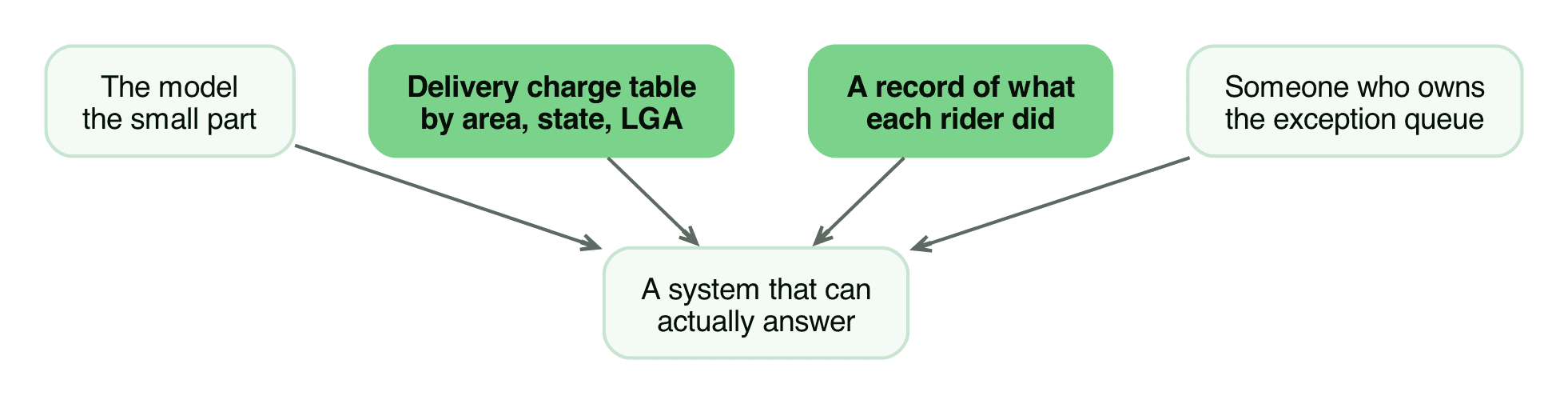
- The data work nobody quotes. For a seller with a Telegram audience, two things decide whether the system can answer anything at all. One is the delivery charge table by area, state and LGA. The other is a record of what each rider actually did. Neither is AI work, and together they are most of the first month.
- Custom system or product build. For when the process is your competitive advantage, or the volumes make renting four subscriptions more expensive than owning one system.
- Monthly retainer. Monitoring, small changes, platform breakage and a monthly review. A project with no maintenance budget degrades quietly inside a quarter.
- Third-party running costs. Model usage, hosting, and metered WhatsApp Business Platform messages. These are yours to pay, not the agency's, and they belong on a separate line in any proposal.
Beware of a fixed price quoted before anyone has looked at your data. The cost of an automation project is mostly the cost of the mess around the process.
That is the shape of the market. Here is what it costs to work with us.
What it costs to work with us
Three steps, and the first one is free. Figures are current at October 2026.
A free consultation. We look at where the money is leaving your business: enquiries nobody answers in time, payments nobody chases, riders nobody hears from, stock claimed twice in the same week. We bring the questions rather than a demo. A supplier who charges you to find out whether you need them is already selling wrong.
A written plan, ₦30,000. What to automate first, in what order, what each piece is worth, and what to leave alone. It is a document you can take to any supplier, including one of our competitors. If the plan shows your leak is smaller than the build, we say so and you keep advice worth the fee.
A build, starting from about ₦564,000. One focused customer source channel, wired end to end from the first enquiry to the completed order, with a month of monitoring.
Any price needs a comparison, and the wrong comparison is another agency's quote. The right one is what the business loses while the process runs by hand. A buyer messages three sellers at 9pm and buys from the one who answers. A transfer sits unchased for a week. A sale sells the same line twice. Put a naira figure on that and the build stops being a cost. It becomes the cheapest way to stop the loss.
We expect a properly used system to recover more than ten times what the build cost in its first full month of running. Hold us to that, and check the number in the plan before you spend anything.
When a product is the better answer
If your customers are already in Telegram and the trouble is serving them, a build is often the expensive answer. eSales runs inside Telegram: a mini app where buyers order, pay and follow their order, plus an assistant that handles the chat and account side on your end. Nobody installs an app. Nobody visits a website.
It takes the checkout, the order notifications, the delivery charge by area, state and LGA, and the stock that cannot be oversold during a sale. If the real problem is that not enough people have heard of you, that is a demand problem, and no build fixes it. We will say so on the free consultation.
Custom work is then for whatever eSales does not cover: the process specific to your business, or the systems you already run that need joining up. A fuller version of eSales, which we think of as a customer operating system, is planned to add acquisition.
Agency, freelancer or in-house developer
Each one is right for a different situation.
- Freelancer. Good for a single, well-defined workflow with clean inputs. Cheaper, faster to start, and a real risk if they disappear mid-project. Ask who owns the code and the accounts.
- Agency. Better when the process crosses several systems, when reliability matters, and when you need someone accountable after launch. More expensive, and worth it when an outage costs you a day of orders.
- In-house developer. The right answer once your automation work is continuous and you can hire and keep a good engineer. Expensive to start, cheapest per change over time.
- The tool alone. If one person on your team is technical and the process is simple, a workflow platform plus a weekend may be all you need. Start there and hire when you hit the ceiling.
The threshold is usually volume plus consequence. Automate with a tool when the cost of an error is small. Hire when a silent failure costs you a day of orders.
How to vet one
Ask these six questions and listen for specifics.
- What did you automate for the last three clients, and what broke? Anyone who has shipped has stories about failure. A supplier with none has not shipped.
- Which parts will be code and which will be a subscription? You are buying a system, not loyalty to one vendor's pricing page.
- Who owns the accounts, the data and the code when we stop working together? The answer should be you, in writing.
- What are the running costs, itemised, in the currency they are billed in? Push for the model usage, hosting and messaging lines separately.
- How will we know it is working? You want named metrics and a way to see them, not a dashboard nobody opens.
- What happens when it fails at 9pm on a Friday? Get the escalation path and the response expectation in the contract.
Then ask for a small paid pilot on one workflow. Any agency confident in its discovery process will accept that. The ones that insist on a large upfront commitment before showing you anything are telling you something.
Where projects go wrong
- No process owner on the client side. Automation needs someone who can answer questions and approve changes. Without one, decisions stall and the project drifts.
- Automating a broken process. If two staff answer the same question differently, you are about to make that disagreement automatic.
- A delivery charge table with no owner. The system quotes whatever the table says, so a stale route price becomes a wrong quote at speed. Somebody has to keep it current.
- A status the buyer cannot trust. If the order record says delivered because a manifest was closed, the automation has automated a lie. Read the rider's report.
- No expiry on an uncollected order. Buyers stock pile because one waybill to the park is cheaper than three. Without a holding period, the box stays on the floor and the stock stays claimed for goods nobody ever collects.
- Skipping the shadow run. Every system should draft first and act later, long enough to count its mistakes.
- Ignoring the exception queue. Every project produces exceptions. Assign an owner before launch, not after.
- Forgetting that platforms change. APIs and pricing change all the time. Maintenance is the difference between a system and a memory.
When not to hire an agency
Do not hire one if you cannot name the process you want fixed, if nobody internally can own it, or if your records are so scattered that the first step would be tidying them. Do the tidying first, or pay someone to do only that.
And do not hire one because the word AI is in your industry's news. Automation multiplies a process that already works. It does not create demand for a product nobody wants.
Where we fit
We build automation systems for Nigerian businesses, and we start with discovery rather than a demo. If you want to see the areas we automate most often and what a build looks like, start with our AI automation practice. If you already know which process is costing you money, bring us the messy version and we will tell you whether it is worth automating.
Work with us
We design, build and automate the software Nigerian businesses grow on.
Stay in the loop
Get the latest updates and insights delivered to your inbox.
More like this
Workflow Automation for Small Businesses: Where to Start
Where to start with workflow automation in a Nigerian small business, which processes to leave alone, what it costs to run, and the order that stops projects stalling.
Read ArticleCRM for Small Businesses That Still Run on Memory
If customer records live in your head, a notebook and WhatsApp, here is the simplest CRM for small business in Nigeria, what it costs, and when software is worth it.
Read Article